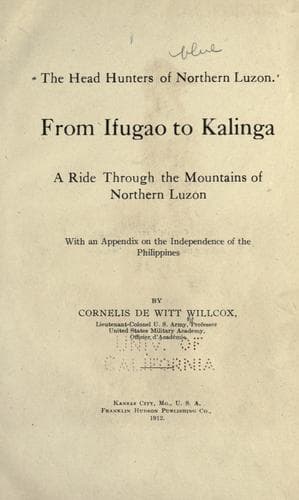
The Head Hunters of Northern LuzonWillcox, Cornélis De Witt
History
The Head Hunters of Northern Luzon
Willcox, Cornélis De Witt
Igorot (Philippine people); Luzon (Philippines) -- Description and travel
Evidently the possibility of obtaining an answer to this question
depends on the possibility of determining, within allowable limits of
precision, the qualities and defects of the Filipino peoples. Now,
this is a difficult thing to do, but it is not an impossible thing;
at any rate, a first approximation may be derived from the authorities
quoted in the "Census of the Philippine Islands," 1903, pp 492 _et
seq._ In time, these authorities range from Legaspi, 1565, to our
own day, and include governors, prelates, travellers, engineers,
priests, etc., among whom are found Spaniards, Englishmen, Americans,
and Filipinos, As might be expected, all sorts of qualities and defects
are reported. Classifying these, and rejecting from consideration all,
whether quality or defect, not supported by at least five authorities,
it may be concluded, so far as this induction goes, that the Filipino
is, on the one hand, hospitable, courageous, fond of music, show,
and display; and, on the other, indolent, superstitious, dishonest,
and addicted to gambling. One quality, imitativeness, is possibly
neutral. It would appear that his virtues do not especially look toward
thrift--_i.e._, economic independence--and that his defects positively
look the other way. If the witnesses testifying be challenged on the
score of incompetency, let us turn to the reports of the supervisors
of the census, contained in the volume already cited; for these
cover the entire Archipelago, and set forth actual conditions at
one and the same epoch, 1903, the date of the census. Moreover,
these supervisors, as welt as the special agents and enumerators,
were nearly all natives. When, therefore, these supervisors report
the mass of the Christianized Filipinos as simple and superstitious,
we may be sure that we have the truth; but we are also inevitably
led to the conclusion of economic unfitness. As this matter of
economic independence is one of the first importance in determining
the future of the Islands, we must look for all the light possible
on the question. A flood is thrown on it by an article entitled
"_Nulla est Redemptio_," published in the (native) _La Democracia_,
of Manila, October 10, 1910, and believed to be the production of
perhaps the ablest Filipino alive to-day. Premising that agriculture is
the chief source of Philippine wealth, and that this source failing,
all others must fail, the author points out that, although taxes are
lighter in the Archipelago than in any other country, production is
much less, and that this is the chief cause of the prevailing economic
distress. He points out further that the Assembly is wholly native,
as are all municipal and nearly all provincial officers, and that
therefore they, and the constituencies that elected them, must assume
responsibility. Now, what has been achieved? The provinces have spent
money on buildings and parks, but, with one brilliant exception, none
on roads. Nothing has been done for agriculture. Of the municipalities,
Public-domain text, read in full here on John Shaqi.
Reviews
Reviews
No reviews yet
Be the first to share your thoughts on this work.
Elsewhere in the archive
Join the Discussion
Join the discussion
Sign in to leave a comment or review.
Sign InorCreate an account