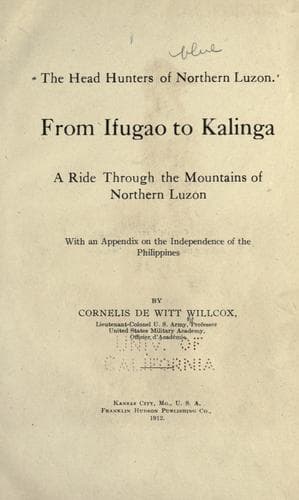
The Head Hunters of Northern LuzonWillcox, Cornélis De Witt
History
The Head Hunters of Northern Luzon
Willcox, Cornélis De Witt
Igorot (Philippine people); Luzon (Philippines) -- Description and travel
qualities that, however commendable in themselves, do not constitute a
foundation on which popular self-government may safely rest. Further,
we mean to grant it to a population which contains no middle class,
to one in which the poor are peculiarly at the mercy of the rich, and
in which nearly all the elements that make for economic independence
are conspicuously lacking.
VI.
What would happen if we were to grant immediate independence to
the Islands? Without having the gift of prophecy, one runs no risk
in declaring that civil war would be almost unavoidable. At least
this is the belief of some well-informed Filipinos, a belief that
appears to have some ground when we take into account, the great
probability of a Tagálog oligarchy. But, without going so far as to
predict armed strife, it would seem that any government, not held
together by some strong external power, would soon begin to break
up. Its various elements, not only differentiated from one another
by speech, but physically separated, in many cases, by the seas,
would tend to fall apart. The Visayas, for example, would refuse
sooner or later to acknowledge the Tagalog supremacy of Luzon. If
we proceed farther south still, what practicable bond can be found
to exist between Mindanao, peopled by Mohammedans and savages,
and Luzon or Panay or Negros? The consequences of such a disruption
as is here predicted must occur to everyone. The gravest of these,
gravest in that it would defeat our purpose in granting independence,
would be foreign intervention. Japan would most certainly insist on
being heard. Now, the Filipinos, as a whole, prefer our sovereignty
to that of the Japanese. England, too, would have a right to interfere
for the protection of her commercial interests in the Archipelago. It
exercised this sort of right, in 1882, by seizing Egypt in behalf of
civilization in general. In the meantime, the Moros of Mindanao and
Jolo would have resumed their piratical excursions to the northward,
burning, killing, and carrying off slaves. If this be questioned,
then let us recollect that as recently as 1897 they carried off slaves
from the Visayas, a sporadic case, probably, but giving evidence that
the disease of piracy is to-day merely latent. Given an opportunity,
it will break out again. Under independence, the large, beautiful,
and fertile island of Mindanao would be left to its own devices,
would be lost to civilization. Upon this point we need have no doubt
whatever. The issue of Filipino control of Mindanao was very clearly
raised, when Mr. Dickinson, the late Secretary of War, visited Mindanao
in August of 1910. Upon this occasion Mr. Dickinson, in response to
a Filipino plea for immediate independence, with consequent control
of the Moros, made a speech in which he declared the unwillingness
of the Government to entrust to the 66,000 Filipinos living in
Mindanao the government of the 350,000 Moros of this province. At
Public-domain text, read in full here on John Shaqi.
Reviews
Reviews
No reviews yet
Be the first to share your thoughts on this work.
Elsewhere in the archive
Join the Discussion
Join the discussion
Sign in to leave a comment or review.
Sign InorCreate an account