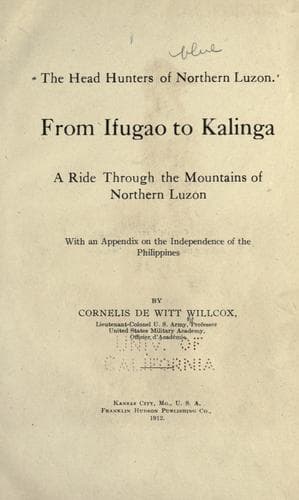
The Head Hunters of Northern LuzonWillcox, Cornélis De Witt
History
The Head Hunters of Northern Luzon
Willcox, Cornélis De Witt
Igorot (Philippine people); Luzon (Philippines) -- Description and travel
To conclude, and in part to repeat: when we took over the Philippines,
we unquestionally at the same time acquired a burden. Of this burden
we can rid ourselves by setting the Islands adrift; or we can declare
that we intend to keep the Islands, as we have kept Porto Rico. In the
light of the argument hereinbefore submitted, which of these courses
appeals to the people of the United States? May we, or may we not,
without incurring an accusation of injustice to a dependent population,
honestly ask ourselves if actual conditions should not sometimes limit
or control the application of an abstract principle? Does our duty in
the premises consist or not in merely satisfying such a principle? Is
it or is it not possible that practical considerations--and what
is practical is not always sordid--may outweigh an abstraction? Is
it or is it not conceivably our duty to use our superior knowledge,
power and experience to the best advantage of those chiefly concerned,
even if these should apparently for a time not agree with us in the
application we purpose to make of our knowledge, power, and experience?
NOTES
[1] See Retana's edition, p. 183, Madrid, 1909.
[2] It is interesting to note that as late as 1889 General Weyler,
then Governor-General of the Archipelago, in establishing various
_comandancias_, drew up regulations for the treatment of the natives,
etc., as remarkable for lenity and good sense as his later measures
in Cuba were, whether justly or not, distinguished for severity.
[3] For an account of the early missions of this order, see the Manila
_Libertas_ of May 23, 1910.
[4] Report of the Secretary of the Interior, Philippine Islands,
1910; Washington Government Printing Office, 1911.
[5] See "Census of the Philippine Islands," Vol. I., p. 453 _et seq.,_
for a discussion of the non-Christian tribes.
[6] Vol. I., p. 60 _et seq_.
[7] Mr. A.H. Savage Landor, in his "Gems of the East," protests against
our practice of boiling water before drinking it, but the experience
of others is against him. He was simply fortunate in not being made
ill by the natural water.
[8] An attempt has been made to stock this river with trout, but it
has proved a failure. The fish grew and throve, but did not breed.
[9] This happened on a large scale in the spring, of this year
(1912). Landslides having occurred on both banks of the cañon, and
as luck would have it, at the same point, the waters rose behind
the natural dam thus formed to a height of over one hundred feet,
and breaking through, scoured the valley in their sweep, completely
wiping out the road.
[10] For a fuller account of Padre Villaverde's labors, see the Manila
_Libertas_ of May 17, 1910. Villaverde remained at his post until his
health broke completely; he set out for Spain, but never reached it,
dying August 4, 1897, and being buried at sea a few hours only from
Barcelona. The great trail he built reduced the cost of transportation
by nine-tenths.
Public-domain text, read in full here on John Shaqi.
Reviews
Reviews
No reviews yet
Be the first to share your thoughts on this work.
Elsewhere in the archive
Join the Discussion
Join the discussion
Sign in to leave a comment or review.
Sign InorCreate an account