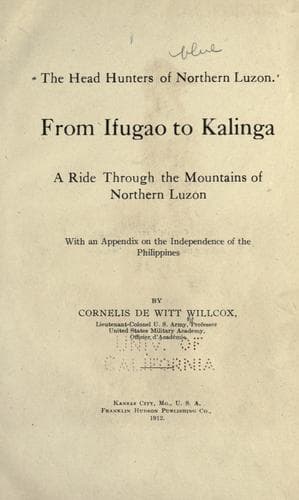
The Head Hunters of Northern LuzonWillcox, Cornélis De Witt
History
The Head Hunters of Northern Luzon
Willcox, Cornélis De Witt
Igorot (Philippine people); Luzon (Philippines) -- Description and travel
[21] According to De Morga (p. 196, Retana's edition), the _anito_
was a representation of the devil under horrible and frightful forms,
to which fruits and fowl and perfumes were offered. Each house had and
"made" (or performed) its _anitos_, there being no temples, without
ceremony or any special solemnity. "This word," says Retana, "is
ordinarily interpreted 'idol,' although it has other meanings. There
were _anitos_ of the mountains, of the fields, of the sea. The soul of
an ancestor, according to some, became embodied as a new _anito_, hence
the expression, 'to make _anitos_.' Even living beings, notably the
crocodile, were regarded as _anitos_ and worshiped. The _anito-figura_,
generally shortened to _anito_, ... was usually a figurine of wood,
though sometimes of gold." (Glossary to his edition of De Morga,
pp. 486-487.)
"The _anito_ of the Philippines is essentially a protecting
spirit." (F. Jagor, "Travels in the Philippines," p. 298. English
translation, London, Chapman & Hall, 1875; originally published in
Berlin. 1873, "Reisen in den Philippinen," Weidmannsche Buchhandlung.)
"The religion of the islands, what may be called the true religion of
Filipinos, consisted of the worship of the _anitos_. These were not
gods, but the souls of departed ancestors, and each family worshipped
its own, in order to obtain their favorable influence." (Pardo de
Tavera, "Reseña Histórica de Filipinas," Manila, 1906.)
[22] _Apo_ means "lord, master." In the mountains every American
is called _apo_. "Sir" in Tagalo is _po_, and the highest mountain
of the Archipelago is named Apo. The native word for fire in these
parts is something like _apo_. To distinguish Mr. Forbes from other
_apos_. he was called _apo apo_ in communicating with the natives.
[23] Now frequently called _ub-ub_, _i.e_., "spring," in the Ifugao
country; a change of name due to Gallman.
[24] See De Morga, "_Sucesos_," etc., p. 184, Retana's edition,
and Retana's note on the passage; see also Jagor, "Travels," etc.,
p. 162 _et seq_.
[25] _Runo_ is a stiff reed grass growing to several feet, the mountain
cousin of the _cogon_ of the plains.
[26] The _Princesa_ was the only fat person we saw in the mountains:
apparently these Highlanders all grow thin with age, and wrinkled
from head to foot.
[27] See _Philippine Journal of Science_, July, 1909, for Villaverde's
account of the Ifugaos of Kiangan, translated and edited by Worcester,
with notes and an addendum by Major Case, of the Constabulary.
[28] Gallman says they also carry their spears point down to cause
the enemy's spears to miss.--_C. De W.W._
Public-domain text, read in full here on John Shaqi.
Reviews
Reviews
No reviews yet
Be the first to share your thoughts on this work.
Elsewhere in the archive
Join the Discussion
Join the discussion
Sign in to leave a comment or review.
Sign InorCreate an account