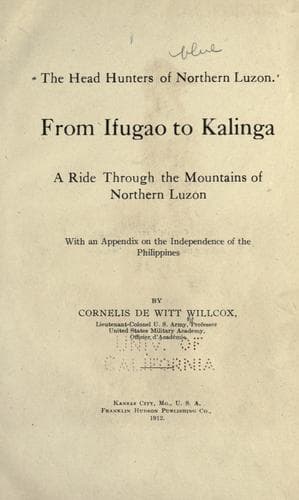
The Head Hunters of Northern LuzonWillcox, Cornélis De Witt
History
The Head Hunters of Northern Luzon
Willcox, Cornélis De Witt
Igorot (Philippine people); Luzon (Philippines) -- Description and travel
[45] The word "Filipino" is taken to mean the civilized, Christianized
inhabitant of Malay origin of the Philippine Islands. As such, it is
convenient and useful. It should be recollected, however, that there
is no such thing as a _Filipino people_. There are Tagalogs, Visayans,
Bicols, Pampangans, Ilokanos, Cagayanes, etc., etc., to say nothing
of the wild people themselves, all speaking different languages;
but these can not be said to form one people.
[46] Retana, in his edition (1909) of De Morga remarks (p. 502):
"To-day there would not be many to dare go from Manila to Aparri by
the road taken by the Spaniards in 1591."
[47] Some Igorots brought down to the Manila carnival of 1912
were forced, at the request of Filipino authorities, to put on
trousers. This was not for comfort's sake, nor yet for decency's,
for the bare human skin is no uncommon sight in Manila. Apparently,
the Filipinos of Manila were unwilling to let the world note that
their cousins of the mountains were still in the naked state.
[48] For a full discussion of this entire matter, see the Report of the
Secretary of the Interior, Philippine Islands, for 1910, Washington
Government Printing Office, 1911, from which the quotations given
above are taken.
[49] E.g. the Mountain Province.--C. De W.W.
[50] It is interesting to note, that since the foregoing report was
published, Captain Harris, Philippine Constabulary, has persuaded
the Kalingas to turn in one hundred and eighty-seven firearms in
their possession, and this without firing a shot himself. What this
means may be inferred from the fact that all over the Islands, whether
among Christians or non-Christians, the desire to have firearms is of
the keenest. The great ambition of the Ifugao is to be a policeman,
and so be authorized to carry a gun. The Moros will give $400.00 for
an Army rifle and a belt of ammunition worth, say, $18.00.--C. De W.W.
[51] _Japan Chronicle_, weekly edition, Kobe, January 5, 1911.
[52] Ibid., same date.
[53] See the weekly Manila _Times_, October 21, 1910.
[54] According to a story current some years ago, a distinguished
officer of our Army serving in the Philippines once remarked to a
justly celebrated native judge of the highest character, that he
had no opinion of the native justice, and added, that for a thousand
pesos he could procure witnesses to prove that the judge had committed
a murder in such a place, although the judge had never been in the
place in his life. "Absurd," remarked the judge. "How absurd?" "You
misunderstand me," answered the judge; "it would be absurd to spend
a thousand pesos on such a purpose when two hundred would suffice."
Public-domain text, read in full here on John Shaqi.
Reviews
Reviews
No reviews yet
Be the first to share your thoughts on this work.
Elsewhere in the archive
Join the Discussion
Join the discussion
Sign in to leave a comment or review.
Sign InorCreate an account