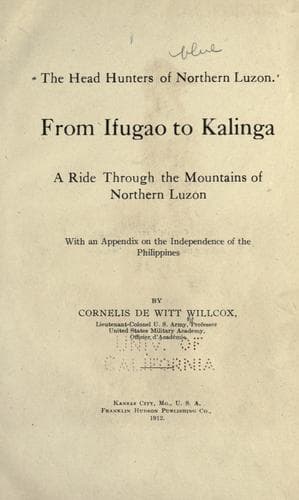
The Head Hunters of Northern LuzonWillcox, Cornélis De Witt
History
The Head Hunters of Northern Luzon
Willcox, Cornélis De Witt
Igorot (Philippine people); Luzon (Philippines) -- Description and travel
The day closed with a _baile_, given by the Ilokanos living in
Bontok. Many of these are leaving their narrow coastal plains on the
shores of the China Sea and making their way through the passes to
the interior, some of them going as far as the Cagayán country. It
is only a question of time when they will have spread over the whole
of Northern Luzon. This _baile_ was like all native balls, _rigodón_,
waltzes, and two-steps; remarkably well done too, these, considering
that the _señoritas_ wear the native slipper, the _chinela_, which
is nothing more or less than a heelless bed-room slipper. But one
_señorita_ danced the _jota_ for us, a graceful and charming dance,
with one cavalier as her partner, friend or enemy according to the
phase intended to be depicted.
CHAPTER XIX
The native village.--Houses.--Pitapit.--Native
institutions.--Lumawig.
The next day, the 9th, Father Clapp very kindly offered to show
Strong and me the native village, an invitation we made haste to
accept. This village, if village it be, marches with the Christian
town, so that we at once got into it, to find it a collection of huts
put down higgledy-piggledy, with almost no reference to convenience of
access. Streets, of course, there were none, nor even regular paths
from house to house; you just picked your way from one habitation to
the next as best you could, carefully avoiding the pig-sty which each
considerable hut seemed to have. I wish I could say that the Igorot
out of rude materials had built a simple but clean and commodious
house! He has done nothing of the sort: his materials are rude enough,
but his hut is small, low, black, and dirty, so far as one could tell
in walking through. The poorer houses have two rooms, an inner and an
outer, both very small (say 6 × 6 feet and 4 × 6 feet respectively,
inside measurement), cooking being done in the outer and the inner
serving as a sleeping-room. There is no flooring; although the fire
is under the roof (grass thatch), no smoke-hole has been thought
of, and as there are no window-openings, and the entrance is shut
up tight by night and the fire kept up if the weather be cold, the
interior is as black as one would expect from the constant deposit
of soot. The ridge-pole of the poorer houses is so low that a man
of even small stature could not stand up under it. The well-to-do
have better houses, not only larger, but having a sort of second
story; these are soot-black, too. We made no examination of these,
not even a cursory one. The pig-sty is usually next to the house,
and is nothing but a rock-lined pit, open to the sky, except where
the house is built directly over it.
It is astonishing that these people should not have evolved a better
house, seeing that the Ifugaos have done it, and the Kalinga houses,
which we were to see in a day or two, are really superior affairs.
Public-domain text, read in full here on John Shaqi.
Reviews
Reviews
No reviews yet
Be the first to share your thoughts on this work.
Elsewhere in the archive
Join the Discussion
Join the discussion
Sign in to leave a comment or review.
Sign InorCreate an account