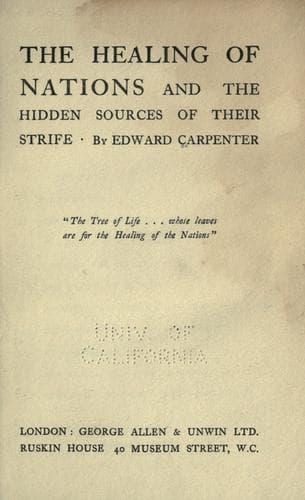
The Healing of Nations and the Hidden Sources of Their StrifeCarpenter, Edward
History
The Healing of Nations and the Hidden Sources of Their Strife
Carpenter, Edward
World War, 1914-1918
"It will be necessary soon to consider the relations of democracy to the
war. The war is a war of nationalities, but it was not made by peoples.
Its begetter was a comparatively small band of unscrupulous, blind, and
conceited persons, who were clever and persistent enough to demoralize a
whole people. In so far as they permitted themselves to be demoralized
the people were to blame, but the chief blame lies on the small band.
Europe is laid waste, hundreds of thousands of men murdered, and
practically every human being in the occidental hemisphere made to
suffer, not for the amelioration of a race, but in order to satisfy the
idiotic ambitions of a handful. Let not this fact be forgotten.
Democracy will not forget it. And foreign policy in the future will not
be left in the hands of any autocracy, by whatever specious name the
autocracy may call itself. Ruling classes have always said that masses
were incapable of understanding foreign policy. The masses understand it
now. They understand that in spite of very earnest efforts in various
Cabinets, the ruling classes have failed to avert the most terrible
disaster in history. The masses will say to themselves, 'At any rate we
couldn't have done worse than that.' The masses know that if the war
decision had been openly submitted to a representative German chamber,
instead of being taken in concealment and amid disgusting chicane, no
war would have occurred. It is absolutely certain that the triumph of
democracy, and nothing else, will end war as an institution. War will be
ended when the Foreign Offices are subjected to popular control. That
popular control is coming."--_Arnold Bennett in the "Daily News," October
15, 1914._
* * * * *
THE FUTURE SETTLEMENT.
Let us turn, then, from the past to the future and ask, first, what the
governmental mind, left to itself, is likely to make of Europe when the
war is finished; secondly, what we, on our part, want and mean to make
of it. What the diplomatists will make of it is written large on every
page of history. Again and again they have "settled" Europe, and always
in such a way as to leave roots for the growth of new wars. For always
they have settled it from the point of view of States, instead of from
the point of view of human life. How one "Power" may be aggrandized and
another curtailed, how the spoils may be divided among the victors, how
the "balance" may be arranged--these kinds of considerations and these
alone have influenced their minds. The desires of peoples, the
interests of peoples, that sense of nationality which is as real a thing
as the State is fictitious--to all that they have been indifferent....
What can be foreseen with certainty is, that if the peace is to be made
by the same men who made the war it will be so made that in another
quarter of a century there will be another war on as gigantic a
scale....
Public-domain text, read in full here on John Shaqi.
Reviews
Reviews
No reviews yet
Be the first to share your thoughts on this work.
Elsewhere in the archive
Join the Discussion
Join the discussion
Sign in to leave a comment or review.
Sign InorCreate an account