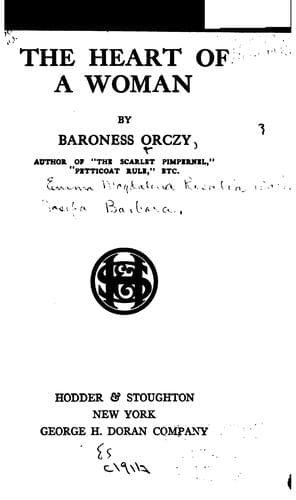
The Heart of a WomanOrczy, Emmuska Orczy, Baroness
General
The Heart of a Woman
Orczy, Emmuska Orczy, Baroness
Murder -- Fiction; Mystery and detective stories
It was her fancy of course. But Luke's eyes were naturally bright, of
varying tones of gray, blue, or green, with never a shadow beneath
them. Now they appeared cavernous and dark, and again as he met her
gaze, that swift flash of intense misery.
No longer had she the feeling that she was living in a dream, no
longer that this was a theatre wherein she and Luke and the dead man
were puppets dancing and squirming for the benefit of shallow-hearted
dolts. That sense of unreality left her together with the hysterical
desire to laugh which had plagued her so in the earlier part of the
proceedings. On the contrary, now an overwhelming feeling of intense
reality oppressed her, so that she could have screamed with the awful
soul agony which the sight of Luke's misery had caused her.
All her nerves were on the rack, her every faculty concentrated on the
one supreme desire to understand and to know.
Love, the omnipotent, had encountered an enemy--grim, unexplained
Mystery--and he sat pondering, almost cowed by this first check to his
supreme might. Louisa had sought and compelled Luke's gaze, and Love
had gleamed in one great flash out of her eyes. Yesterday, at her
glance, he had knelt at her feet and buried his sorrow with his
aching head in the scented palm of the dearly loved hand.
To-day the look of Love brought but a surfeit of misery, an additional
load of sorrow. The eyes in response remained tearless and hard and
circled with the dark rings of utter hopelessness.
I'll grant you that if Louisa Harris had been an extraordinary woman,
a woman endowed with a wonderfully complex, wonderfully passionate, or
wonderfully emotional nature--if, in fact, she had been the true
product of this century's morbid modernity--she would, whilst
admitting Luke's guilt, have burned with a passion of self-sacrifice,
pining to stand beside him pilloried in the dock, and looking forward
to a veritable world of idealistic realism in the form of a
picturesque suicide, after seeing the black flag hoisted over Newgate
prison.
But Louisa, though a modern product of an ultra-modern world, was an
absolutely ordinary woman--just a commonplace, sensible creature who
thought and felt in a straight and essentially wholesome manner.
Though she had read Tolstoi and Dostoyefsky and every Scandinavian and
Russian crack-brain who has ever tried to make wrong seem right, black
appear white, and animalism masquerade as love, yet she had never been
led away from her own clean outlook on life.
She loved Luke and would have given--did in fact give--her whole life
to him: but she loved him without analysis or thought of self. It
never entered her mind at this moment to wonder if he were guilty or
not guilty, if he was capable or not of committing a crime to gain his
own ends. All that troubled her was his misery, which she would have
given her very soul to alleviate, and the hopelessness in him which
she had given the world to console.
Public-domain text, read in full here on John Shaqi.
Reviews
Reviews
No reviews yet
Be the first to share your thoughts on this work.
Elsewhere in the archive
Join the Discussion
Join the discussion
Sign in to leave a comment or review.
Sign InorCreate an account