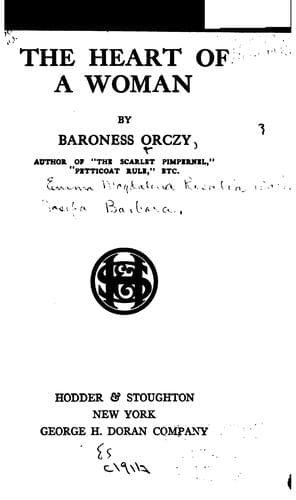
The Heart of a WomanOrczy, Emmuska Orczy, Baroness
General
The Heart of a Woman
Orczy, Emmuska Orczy, Baroness
Murder -- Fiction; Mystery and detective stories
"Lord Radclyffe accorded to the deceased the position which he thought
fitting that he should occupy."
"You know that the servants in Lord Radclyffe's household have
informed the police that in consequence of Mr. Philip de Mountford's
advent in the house, you and your brother and sister had to leave it?"
"My brother, sister, and I now live at Fairfax Mansions, Exhibition
Road," said Luke evasively.
"And the relations between yourself and the deceased have remained of
a very strained nature, I understand?"
"Of an indifferent nature," corrected Luke.
There was a pause. So far these two--the coroner and the witness--had
seemed almost like two antagonists going through the first passes of a
duel with foils. Steel had struck against steel, curt answers had
followed brief questions. Now the combatants paused to draw breath.
One of them was fighting the preliminary skirmish for his life against
odds that were bound to overwhelm him in the end: the other was just a
paid official, indifferent to the victim, interested only in the
issue. The man standing at the foot of the table was certainly
interesting: the coroner had made up his mind that he was the guilty
party--a gentleman and yet a cowardly assassin; he amused himself
during this brief pause with a quick analysis of the high-bred,
impassive face--quite Saxon in character, fair and somewhat heavy of
lid--in no way remarkable save for the present total lack of
expression. There was neither indifference nor bravado, neither fear,
remorse, nor defiance--only a mask made of wood, hiding every line of
the mouth, and not allowing even the eyes to show any signs of
vitality.
Beyond that the whole appearance was essentially English: the fair
hair neatly groomed, with just a suspicion of curl here and there, and
a glint of gold in the high lights, the stiff neck encased in its
immaculate collar, the perfectly tailored clothes, the hands, large
but well-formed and carefully tended, which lightly interlaced, hung
in marble-like stillness before him.
When a man happens to be out in mid-winter with a stout stick in his
hand, and he comes across a layer of ice on the top of a pool or a
trough of water, he always--or nearly always--is at once a prey to the
silly desire to break that layer of ice. The desire is irresistible,
and the point of the stick at once goes to work on the smooth surface,
chipping it if not actually succeeding in breaking it.
The same desire exists in a far stronger degree when the ice is a
moral one--one that covers the real nature of another man: the cold
impassiveness that hides the secret orchard to which no one but the
owner has access. Then there is an irresistible longing to break that
cold barrier, to look within, and to probe that hidden soul, if not
within its innermost depths, at any rate below the ice-bound surface;
to chip it, to mark it and break its invincible crust.
Public-domain text, read in full here on John Shaqi.
Reviews
Reviews
No reviews yet
Be the first to share your thoughts on this work.
Elsewhere in the archive
Join the Discussion
Join the discussion
Sign in to leave a comment or review.
Sign InorCreate an account