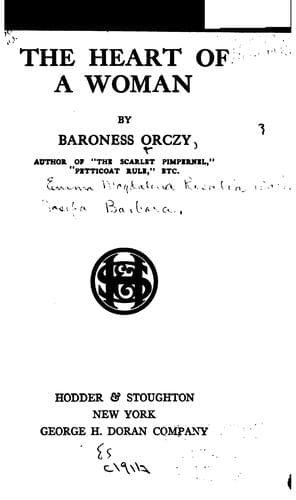
The Heart of a WomanOrczy, Emmuska Orczy, Baroness
General
The Heart of a Woman
Orczy, Emmuska Orczy, Baroness
Murder -- Fiction; Mystery and detective stories
Hot, tired, and oppressed humanity made its warm breath felt in the
close, ill-ventilated room. Smelling-salts would not dispel the
unpleasantly mingling odours of damp clothes and muddy boots which
rose from the plebeian crowd in the rear.
But nobody stirred; no one would have thought of leaving before the
last act of this interesting play. The chief actor was not on the
stage for the moment, but his presence was felt. It was magnetic in
its appeal to excitement. Every question put by the coroner, every
reply given by the witnesses, had, as it were, Luke de Mountford for
its aim: every word tended toward him, his undoing, the enmeshing of
his denials in the close web of circumstantial evidence.
Then a diversion occurred.
The man in the shabby clothes, who looked like a beetle, and who had
marshalled his companions into the court room early in the day, was
called upon by the usher to come forward. His strange, poorly-clad
figure detached itself from the groups immediately round him, his
long, loose limbs seeming to swing themselves forward.
His four companions--the three women and the other man--were seized
apparently with great agitation and whispered eagerly among
themselves. No one in the crowd could guess why these people had been
called. They seemed so completely out of the picture which had its
invisible frame in Grosvenor Square.
"Go on, Jim!" whispered one of the young women, "they can't do nothing
to ye."
And the beetle-like creature shambled forward, with arms gangling
beside him, a humble, apologetic look on his care-worn face. He might
have been any age from thirty to sixty; time and a perpetual struggle
for existence had wiped way all traces of actual age. The cheeks were
hollow, and eyes, mouth, and moustache had a droop which added to the
settled melancholy of the face.
He was obviously very nervous and looked across at his own friends,
who strove to encourage him by signs and whispers.
He nearly dropped the Bible when it was handed to him, and no one
could really hear the oath which he repeated mechanically at the
usher's bidding.
At last he mustered up a sufficient amount of courage to state his
name and address.
"James Baker," he said in answer to the coroner's question.
"Bricklayer by trade."
"And where do you live?"
"At 147 Clapham Junction Road, sir," replied the man, scarcely above a
whisper.
"Speak up, please," admonished the coroner, "the jury can't hear you.
You came here, I understand, prepared to make a statement?"
"Yes, sir."
"Of what nature?"
The man shifted his position from one leg to the other. Heavy beads of
perspiration stood out on his pallid forehead.
"Go on, Jim; don't be afeeard," came from the body of the court.
"Silence there!" commanded the usher.
"I wished to say, sir," resumed the man, trying to steady his voice,
"that the deceased whom I saw lying in the coffin yonder is my own
son, Paul Baker, sir."
"Your son!"
Public-domain text, read in full here on John Shaqi.
Reviews
Reviews
No reviews yet
Be the first to share your thoughts on this work.
Elsewhere in the archive
Join the Discussion
Join the discussion
Sign in to leave a comment or review.
Sign InorCreate an account