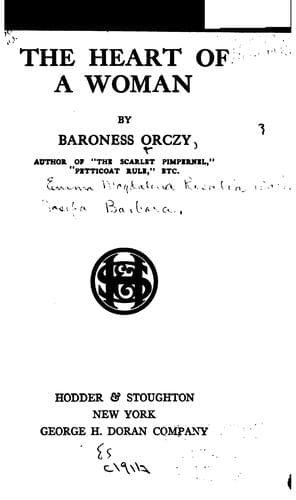
The Heart of a WomanOrczy, Emmuska Orczy, Baroness
General
The Heart of a Woman
Orczy, Emmuska Orczy, Baroness
Murder -- Fiction; Mystery and detective stories
"Yet I tell you, uncle," she reiterated with firmness at least equal
to his own, "that Luke never killed that man, and that he pleads
guilty to the crime in order to shield some one else."
"Whom?" he retorted.
"That I do not know--as yet. But that is the reason why I came here
to-night, uncle: because you must help me to find out."
Sir Thomas abruptly rose from his chair, and took his stand on the
hearth rug, with legs apart, and slender hands buried in the pockets
of his trousers, in the attitude dear to every Englishman.
His eyes in their framework of innumerable wrinkles looked down, not
unkindly, at the pale, serious face of the girl before him.
He, who was accustomed to give every scrap of advice, every senseless
piece of title-tattle its just meed of attention, was not likely to
leave unheeded the calm assertions of a woman for whom he had great
regard, and who was the daughter of a brother officer and one of his
best friends. Of course the girl was in love with de Mountford, so her
judgment on him was not likely to be wholly unbiassed: at the same
time Sir Thomas--like all men who have knocked about the world a great
deal, and seen much of its seamy side--had a great belief in woman's
instinct, as apart from her judgment, and he was the last man in the
world to hold the sex in contempt.
"Look here, my dear," he said after a little while, during which he
had tried to read the lines in the interesting face turned up toward
him, "I honour you for your sense of loyalty to de Mountford, just the
same as I honour your father for the like reason. And in order to
prove to you that I, individually, would be only too happy to see the
man's innocence established beyond a doubt, I am going to argue that
soberly and sensibly with you. You hold the theory that Luke de
Mountford is shielding some one from the consequences of an awful
crime by taking the burden on himself. Now, my dear, as I told you
before, people don't do that sort of thing nowadays. In olden times,
the consequences of a crime--especially where the aristocracy was
concerned--were quite picturesque: the Tower, the block, and all that
sort of thing. But to-day the paraphernalia of vengeful justice is
very sordid, very mean, and anything but glorious. It means the
lengthy inquiry before a police magistrate, then the trial, the past
dragged up to the light, the most private secrets thrown to the morbid
curiosity of the million. In order to face that sort of thing, my
dear, a man must be either guilty--then he cannot help it; or
wrongfully accused--then he hopes for the establishment of his
innocence. But a man does not prepare himself to face all that out of
Quixotic motives alone, knowing himself to be innocent and because he
desires that another should be spared those awful humiliations and the
chance of a disgusting and shameful death."
"What do you mean by all that, Uncle Ryder," she asked.
Public-domain text, read in full here on John Shaqi.
Reviews
Reviews
No reviews yet
Be the first to share your thoughts on this work.
Elsewhere in the archive
Join the Discussion
Join the discussion
Sign in to leave a comment or review.
Sign InorCreate an account