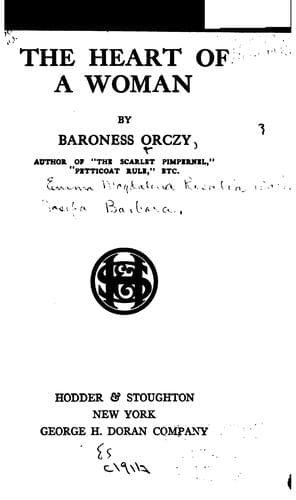
The Heart of a WomanOrczy, Emmuska Orczy, Baroness
General
The Heart of a Woman
Orczy, Emmuska Orczy, Baroness
Murder -- Fiction; Mystery and detective stories
"It was useless, my dear," he said, "and Doctor Newington was quite
right. Lord Radclyffe, I am sorry to say, is hardly conscious. He is,
evidently, unable to understand what is said, and certainly quite
incapable of making any effort to reply."
"I was afraid so," added Doctor Newington in his usual conventional
tones, "the patient, you see, is hardly conscious. His mind is
dormant. He just knows me and his nurses, but he did not recognize Sir
Thomas."
Louisa said nothing: the blank, hopeless disappointment following on
the excitement of the past two hours was exceedingly difficult to
bear. The ruling passion--strong even in the midst of despair--the
pride that was in her, alone kept her from an utter breakdown. She was
grateful to her uncle, who very tactfully interposed his tall figure
between her and the indifferent eyes of the doctor. Mr. Warren looked
more sympathetic than ever, and that was just as trying to bear as the
pompousness of Doctor Newington.
As a matter of fact, Louisa had absolutely ceased to think. The whole
future from this moment appeared as an absolute blank. She had not
begun to envisage the possibility of going back to the hotel, having
utterly failed in accomplishing that which she had set mind and heart
to do: the throwing of the first feeble ray of light on the
impenetrable darkness of Luke's supposed guilt. She certainly had not
envisaged the going to bed to-night, the getting up to-morrow, the
beginning of another day with its thousand and one trivial tasks and
incidents, all the while that she had failed in doing that which alone
could prevent the awful catastrophe of to-morrow!
Luke standing in the dock, like a common criminal!
"I'll just see about getting a cab, dear," said her uncle kindly.
The first of those thousand and one trivialities which would go on and
on from now onward in endless monotony, whilst Luke prepared for his
trial, for his condemnation, perhaps for death.
It was indeed unthinkable. No wonder that her mind rebelled at the
task, refusing all thoughts, remaining like a gray, blank slate from
which every impression of past and future has been wiped out.
Sir Thomas Ryder went out of the room, and Mr. Warren went with him.
They left the door ajar, so she could hear them talking in the hall.
Mr. Warren said:
"Don't go out, Sir Thomas. It's a horrid night. Fletcher will get you
a cab."
And Sir Thomas replied: "Thank you."
"Won't you," said the younger man, "wait in the library?"
He had apparently rung a bell, for the man servant came into the hall
and was duly told off to whistle for a cab.
"I'd rather go into another room, for a moment, Mr. Warren, if I may,"
said Sir Thomas. "There are just one or two little questions I would
like to put to you."
"Certainly, Sir Thomas," replied Mr. Warren with alacrity.
Public-domain text, read in full here on John Shaqi.
Reviews
Reviews
No reviews yet
Be the first to share your thoughts on this work.
Elsewhere in the archive
Join the Discussion
Join the discussion
Sign in to leave a comment or review.
Sign InorCreate an account