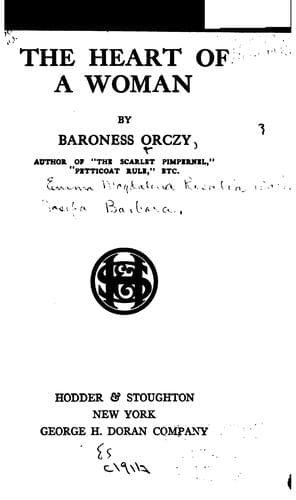
The Heart of a WomanOrczy, Emmuska Orczy, Baroness
General
The Heart of a Woman
Orczy, Emmuska Orczy, Baroness
Murder -- Fiction; Mystery and detective stories
"I know very little about the business, Mr.--er--Travers," remarked
Luke as soon as all three of them had stowed themselves fairly
comfortably in the interior of the vehicle. "I suppose it is about
this ghastly affair that you wanted to speak to me."
"Yes, sir. It was about that. I thought you could give us some
information about the late Mr. de Mountford's past life, or his former
friends."
"I know nothing," retorted Luke dryly, "of my cousin's past or present
life. He did not confide in me."
"But you were good friends?" interposed the other quickly.
"We knew each other very little."
"And to-night?"
"I saw him at his club."
"Where was that?"
"The Veterans' in Shaftesbury Avenue."
"About what time?"
"Between eight and nine."
"You had some talk with him?"
"Yes."
"Pleasant talk?" asked the officer indifferently.
"Family affairs," rejoined Luke dryly.
"And you parted from him?"
"Somewhere about nine."
"In the club?"
"In the club."
"The door steps?"
"No. The lobby."
"He was alone then? I mean--besides yourself was no one with him?"
"No one. The hall porter stood there of course."
"No one joined him afterward?"
"That I cannot say. When I parted from him he was alone."
"You know that Mr. Philip de Mountford was murdered in a taxicab
between Shaftesbury Avenue and Hyde Park Corner, soon after nine
o'clock?"
"I have heard most of the details of that extraordinary crime.
"And you can throw no light on it at all?"
"None. How could I?"
"Nothing," insisted the police officer, "occurs to you at this moment
that might help us in any way to trace the murderer?"
"Nothing whatever."
The man was silent. It seemed as if he was meditating how best to put
one or more questions. Up to now these had been curt and to the point,
and as they followed one another in quick succession there was a
marked difference in the attitude both of the questioner and the
questioned. The police officer had started by being perfectly
deferential--just like a man accustomed to speak with people whose
position in the world compelled a certain regard. He had originally
addressed Luke as "sir," just as he had invariably said "my lord" to
Lord Radclyffe, but now he spoke much more curtly. There was a note of
demand in every question which he put, a peremptoriness of manner
which did not escape the observation of his interlocutor.
As the one man became more aggressive so did Luke also change his
manner. There had been affable courtesy in his first reply to the
questions put to him, a desire to be of help if help was needed, but
with his senses attuned by anxiety and nerve strain to distinguish
subtle difference of manner and of intention, he was quick enough to
notice that he himself was as it were in a witness box, with a counsel
ready enough to bully, or to trip up any contradictory statement.
Public-domain text, read in full here on John Shaqi.
Reviews
Reviews
No reviews yet
Be the first to share your thoughts on this work.
Elsewhere in the archive
Join the Discussion
Join the discussion
Sign in to leave a comment or review.
Sign InorCreate an account