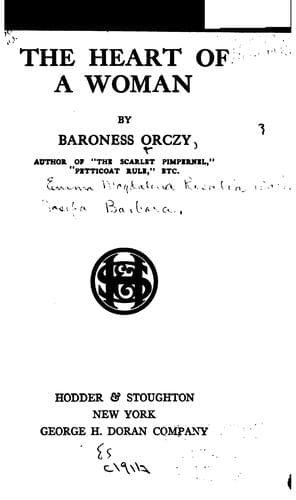
The Heart of a WomanOrczy, Emmuska Orczy, Baroness
General
The Heart of a Woman
Orczy, Emmuska Orczy, Baroness
Murder -- Fiction; Mystery and detective stories
What the man near him said in answer to his retort he really could not
say. He had not heard, for in a moment his thoughts had flashed back
to that lonely vigil in the fog, to the sound of her voice, which
came, oh! so faintly, to his ear, and then to the first breath of
gossip that came from the passers-by, the coachmen and chauffeurs who
had drawn up in long rows along the curb, the idlers who always hang
about outside in the cold and the damp when a society function is in
progress, the pickers-up of unconsidered trifles, lost or willingly
bestowed.
From these he had first heard the news: vaguely at first, for he did
not--could not--realize that the amazing thing which was being
commented on and discussed had anything to do with him. The talk was
of murder, and soon the name of de Mountford was mentioned. The
details he got were very confused, and the open allusions as to "seek
whom the crime will benefit" never really reached his brain, which was
almost numb with the violence of the shock.
His first thought after that was to go and see Uncle Rad: he had, for
the moment, almost forgotten Louisa. Every other interest in life sank
to nothingness beside the one clear duty: Uncle Rad would be alone;
the awful news must be broken very gradually to Uncle Rad. He had
hurried to Grosvenor Square, only to find that emissaries of the
police had forestalled him in his duty.
All this he could not explain to the man Travers. It would have
sounded lame and barely plausible. Nowadays men do not walk outside
houses wherein their liege lady dwells, and, if they do, they do not
choose a foggy night for the sentimental dalliance. He was thankful,
therefore, that Travers put no further questions to him, and merely
said with a return to his original politeness:
"I am greatly obliged to you, sir. I don't think I need detain you any
longer. You said you had an engagement later on; won't you keep this
cab?"
Luke thanked him, but refused the offer of the cab.
"It is close by," he said.
"May I call on you to-morrow morning, sir?"
"If it is necessary."
"I am afraid so. You see we don't like to trouble Lord Radclyffe and
we must try and obtain knowledge of certain facts and verify others."
"Quite so. Well, to-morrow then."
"Thank you, sir. Your address is----?"
"Fairfax Mansions, Exhibition Road."
"Such a nice neighbourhood. No fog there to-night I think."
"I hope not. Good night."
"Good night, sir."
Luke made his escape from the cab. He was afraid of missing Louisa and
her father. His thoughts were somewhat in a whirl, and--being
overburdened with matters of paramount importance--were inclined to
dwell on trifles.
"I ought," he reflected, "to have taken that man's cab. It might be
difficult to get another and Colonel Harris hates waiting in a crowded
hall."
CHAPTER XVI
AND THE PUPPETS DANCED
And so he went to meet Louisa and Colonel Harris at the Danish
Legation, and found them a taxicab and generally saw to their
comparative comfort.
Public-domain text, read in full here on John Shaqi.
Reviews
Reviews
No reviews yet
Be the first to share your thoughts on this work.
Elsewhere in the archive
Join the Discussion
Join the discussion
Sign in to leave a comment or review.
Sign InorCreate an account