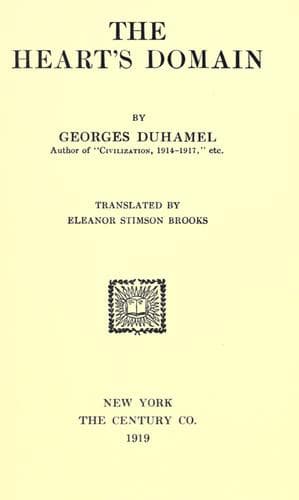
French essays -- Translations into English; World War, 1914-1918 -- Influence
So be it! If the present refuses to yield its manna, we will draw upon
our last resources. If the times overwhelm us with bitterness, we will
flee to our refuges, where we have nothing to fear from intruders or
masters or tormentors.
Common-sense folk, who have the secret of debasing life in the name
of a reason that is more mischievous than actual stupidity, are in
the habit of devoting an almost superstitious worship to the present
reality. To tell the truth, they are greatly afraid that the taste for
memory and hope will turn young men away from that immediate action
which is necessary for the conquest and preservation of material wealth.
They honor with great pomp the origins in the past of those traditions
that are favorable to them; and the way they invoke and prepare for the
future loads the present with chains and shackles.
They dread, in reverie, an enemy of action. As if there were any great
actions that have not their source in great dreams!
These people deceive themselves. They sacrifice an unequalled
consolation to the needs of a fleeting fortune. But do not imagine that
the failure of their fortune leaves these men utterly abandoned: the
refuges open gladly, even for those who have despised them.
III
An intimate friend once said to me, as he watched his little son
playing: “You see; he’s no longer the baby you knew last year. He’s
another child. I have been cheated of the one I had last year. I shall
never have him again. I have lost a child.”
O dear, big heart, how beautiful and how unjust those words are! How
human! How they overflow with ingratitude and with adoration!
You know quite well that every object that appears on the horizon of
our souls has, for us, two existences. One is sudden, sharp, almost
always penetrated with an intense and, so to say, corrosive flavor:
that is the existence of the present. Men agree in recognizing that its
duration is hardly measurable. But the other existence is perennial, as
ample as the measure of our life and our thoughts; in this sense it is
almost infinite.
Thus each moment of the present survives in memory for years, and
doubtless for centuries, since posterity can gather up and prolong the
best of our acts and our works.
It is true, my friend, that each moment dispossesses us, even of the
object we never withdraw our arms from. The miser, infatuated with
his material riches, may well suffer agony of mind over them, but we,
we? Do we not know that each moment restores to us, transfigured, all
the treasures it has snatched away from us? It robs us of the frailer
blessings, it offers us imperishable blessings, less mortal than
ourselves.
Public-domain text, read in full here on John Shaqi.
Reviews
Reviews
No reviews yet
Be the first to share your thoughts on this work.
Elsewhere in the archive
Join the Discussion
Join the discussion
Sign in to leave a comment or review.
Sign InorCreate an account