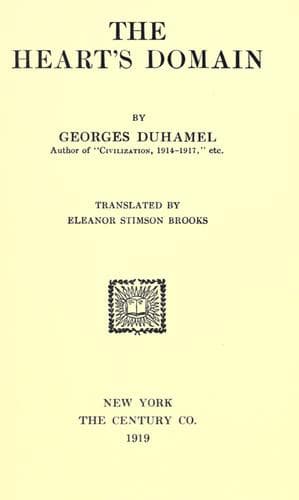
French essays -- Translations into English; World War, 1914-1918 -- Influence
“What makes hope so intense a pleasure,” writes M. Bergson, “is that
the future, which we fashion to suit ourselves, appears to us at one
and the same time under a multitude of forms, all equally smiling,
equally possible. Even if the most desirable of them all is realized,
we must have sacrificed the others, and we shall have lost much. The
idea of the future, pregnant with infinite possibilities, is therefore
more fertile than the future itself, and that is why we find more
charm in hope than in possession, in reverie than in reality.”
The idea of the future alone interests us: that alone is our treasure,
that alone is endowed with existence. It is that indeed which we call
the future. And if M. Bergson, at the end of these admirable lines,
creates a distinction between the future and the idea of the future, he
does not make us forget that he has just, and as if by design, caused
the confusion; for what “we fashion to suit ourselves” is the idea of
the future, and nothing else. But, following the example of M. Bergson,
let us call our idea of the future the future itself.
This idea is our cherished fortune. Certainly we take a passionate
interest in seeking, in what flows out of the present, something that
resembles the realization of our dreams. And yet their realization,
like their failure, marks, in every sense, their end, their exhaustion.
And that is insupportable to us. Whatever fate the present reserves for
our imaginings, we labor every day, as fast as time devours them and
destroys them by making them finite, to push them further back into the
infinite, to prolong them, to reconstruct them, so that we may never
have less of a future at our disposal.
This need of a future, which has no other connection than our hope with
the rugged actuality of the present, is so deep-rooted, so generally
human a thing, that one cannot contemplate it without a respect which
is almost religious. In order that this future, so pregnant with
dreams, should be as necessary as it is to the moral life of most
men, it must represent a truly incomparable treasure. The embrace we
throw around it is the close and powerful embrace we reserve for those
possessions that lie nearest our hearts. And, since we have already
detached the word “possession” from the gross meaning that is usually
attributed to it, let us say that the possession of a dream, when it
assures our happiness, is a reality less debatable and less illusory
than the possession of a coal-mine or a field of wheat.
But as there is no possession without conquest, without effort, we must
merit our dreams and cultivate them lovingly.
If people who have taken the mould of reason reproach us with
distracting for a moment the men of that practical reality which
pretends to be preparing the future, we are ready to reply to them:
Public-domain text, read in full here on John Shaqi.
Reviews
Reviews
No reviews yet
Be the first to share your thoughts on this work.
Elsewhere in the archive
Join the Discussion
Join the discussion
Sign in to leave a comment or review.
Sign InorCreate an account