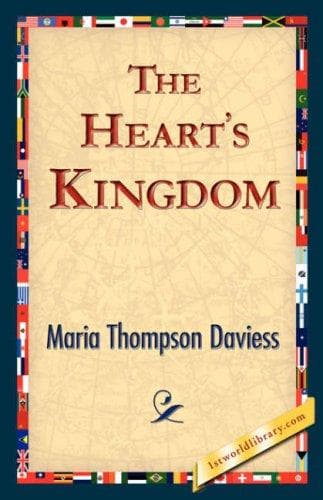
Man-woman relationships -- Religious aspects -- Fiction; Methodist Church -- Clergy -- Fiction
"Cliff said not a week ago that your eyes made him feel like a light he
saw ahead on a wooded island after he had drifted without a paddle two
days in a canoe one time in Canada. You'll have to talk to him. Give him
a little life kernel; I've only got shells for myself. I'm going down to
Florida suddenly next week and when I come back I--I, well, I'll either
go into the movies or study with Mother Spurlock to get a deaconess'
cap." As she spoke I saw that the fight was on in Jessie's soul, and it
would be to a finish.
"God bless and keep you, dear," I held her back long enough to say as
she picked up her sweater and left me. Hampton Dibrell has been
constantly with Bessie Thornton since Ted Montgomery's death, and I knew
that Jessie's time of trial had come, for her love for him had grown
through her denial because of the taint of her mad mother. And somehow I
felt sure of the outcome, that she would find strength to let him go. I
didn't know why I felt so sure; but I did, and I went down to the
library with a great peace in my heart that I knew later would be in
hers.
And I made my entry into father's den in the midst of a scene of great
moment. I paused and listened with profound respect. Tradition was on
trial and the result I felt would be momentous. Father sat in his huge
chair before a small crackling fire in the wide chimney, and Martha's
boy stood before him with a large, profusely illustrated volume of Hans
Christian Andersen clasped passionately to his little breast. He had the
floor.
"And Charlotte said they is no fairies anywhere and I say they is," he
declaimed, while father listened attentively. Suddenly I saw what I had
never seen before, that father's white hair rose in a crest on one side
and descended in a cascade on the other at exactly the same angle as the
black locks of the young arguer before him, and as they calmly regarded
each other I thought I had never seen such a likeness in personality as
well as form of feature. Love flooded all over me and I wanted to hug
them both but was restrained to silence by the gravity of the
situation.
"And why did you argue that there are fairies?" father interrogated
calmly and judicially.
"Charlotte said they ain't here 'cause she and me had never saw one, and
I said, 'How could a book and pictures be about nothing at all?' I
showed her this book that Lady gaved me and she said, 'Maybe, but ask
Minister.' I said, no, I'd ask you 'cause you are older and mighter saw
one onct. Did you?"
"Well, sir, you argued from a positive, about ten pounds of positive, I
should judge from the size of that volume, while Charlotte certainly
argued from a negative viewpoint," said father, and his eyes twinkled as
he gave me an almost imperceptible wink. By his answer he also avoided
answering the question of faith put to him.
"Did you see one?" came back the question in a tone that demanded an
answer.
Public-domain text, read in full here on John Shaqi.
Reviews
Reviews
No reviews yet
Be the first to share your thoughts on this work.
Elsewhere in the archive
Join the Discussion
Join the discussion
Sign in to leave a comment or review.
Sign InorCreate an account