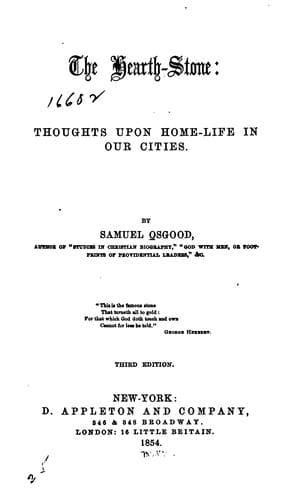
The Hearth-Stone: Thoughts Upon Home-Life in Our CitiesOsgood, Samuel
Religion
The Hearth-Stone: Thoughts Upon Home-Life in Our Cities
Osgood, Samuel
Christian life; Conduct of life
Sometimes when he thinks himself a prodigy of care and industry, and in
the fever of hurry and anxiety, he is almost ready to give up every holy
thought and Christian feeling for the absorbing chase, is not his very
turmoil the fruit of slothfulness? If he had been better disciplined, more
thoughtful, more methodical, would he not have been spared all this fever
of mind, and excepting, perhaps, certain peculiar emergencies, would not
the care as well as the evil of each day have been sufficient for itself,
and send him to his home with heart open to friendly affections, and ready
to thank Heaven for sweetening the repose of his pillow by the work he has
done? Surely there is no way to make business so troublesome as by
neglecting it. The only way of being rid of it, is to do it well, and the
most thorough and careful system is more favorable to peace and
spirituality of mind than slipshod negligence. If a man does not attend to
his business it will attend to him, and dog him night and day, like a
baying hound in chase of a stricken deer. If a man goes beyond negligence
and is dishonest, so much the worse, for the best experience says, that
dishonesty is a mistake, as well as a vice--the poor resort of bunglers in
trade, as well as pigmies in morals. Nothing frets, and in the end
confounds a man more than to patch together a tissue of lies, and this
trouble a thorough business training must shun.
The very habit of earnest attention is wholesome, and need not end where
it begins. Sluggishness of mind and heart is a sad foe to all true life,
and he who studies generously, and does earnestly the work of any worthy
calling, so far educates himself, and is open to all better influences by
the discipline. Who of us, whatever our vocation, is not willing to take
very modest views of himself in this respect? Whether in one of the
learned professions, or in mercantile pursuits, have we been awake to the
highest aspects of our position, and used its opportunities so well, that
we may sincerely call it a liberal vocation? How many professional men
there are, who are mere drudges among drugs, parchments, and ceremonials?
how many merchants, may I not say, are there, who are profoundly ignorant
of the history and relations of their own craft, ignorant of that
wonderful science of trade which is changing the face of the world, and
placing itself among the momentous facts of Providence. Consider the
opportunities of a merchant to observe character, to study times, and
nations; to procure the arts, books, and society best for the mind; to
trace even the changes in the market to causes that connect themselves
with the world's want or welfare,--then say, who is not slothful in
business? Think too, of the best practical examplars of mercantile
culture,--how much of those two ruling forms of practical ability, the
soldier's and the statesman's, have combined in the merchant's enterprise
and comprehension, and an emphasis beyond that of the market-place will
Public-domain text, read in full here on John Shaqi.
Reviews
Reviews
No reviews yet
Be the first to share your thoughts on this work.
Elsewhere in the archive
Join the Discussion
Join the discussion
Sign in to leave a comment or review.
Sign InorCreate an account