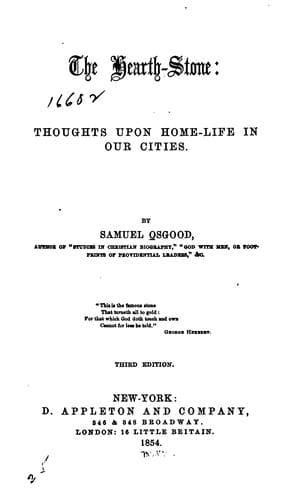
The Hearth-Stone: Thoughts Upon Home-Life in Our CitiesOsgood, Samuel
Religion
The Hearth-Stone: Thoughts Upon Home-Life in Our Cities
Osgood, Samuel
Christian life; Conduct of life
But how apply these thoughts to business now,--how insist upon fervor of
spirit in pursuits whose aim is money-making; and, on our own principles,
is not the spirit of trade itself the thing needed? We reply that
money-making of itself is not the proper or the general end of trade, but
only a means to a higher end. Trade is one of the essential forms of
industry, and a true man will pursue it that he may do his part well in
the world, and care well for all who depend upon or who justly claim his
care. Money is one step in the process, not the end, and that man is a
poor creature, below even the common worldly standard, whose success,
instead of fixing his thoughts on his hoards, does not fill his mind and
heart with new hopes for his family and friends, and people his unromantic
counting-house with hovering images of his children and home, visions of
ampler culture and nobler charities. Leaving out of the account some
miserable creatures, who heap up gold for themselves, and crush their
heart under the heap, we must allow that there is much heart in trade, and
the better class of business men have kindly and elevated aims in view.
How much the arts and sciences, letters, philanthropy, and religion, owe
to the merchant, the whole career of commerce shows. Think of what trade
has done for the higher aims of society; study the fruits of commerce in
modern times; read of the Medici, the Roscoes, the Gurneys, and the noble
men in our land who have endowed our best institutions, and say what you
please of the miser, but say not a word against the true merchant. Justice
may be his ruling virtue, but mercy is not wholly absent, since
forgiveness is often called for, and no liberal merchant can be found who
cannot repeat honestly the prayer, "Forgive us our debts, as we forgive
our debtors." There is much heart in trade, yet not enough by any means,
and a cold worldliness sometimes gains ground with those worthy of better
things, and, in fact, desirous of better things. Men worthy of better
things become more superficial and ostentatious with time and increased
means, and, instead of acting independently and sensibly, join in vain
rivalry of a set of people, whose emptiness is proved every time their
mouths are opened. When shall the due check be found, and the true heart
abound, and the spirit be fervent indeed?
* * * * *
Public-domain text, read in full here on John Shaqi.
Reviews
Reviews
No reviews yet
Be the first to share your thoughts on this work.
Elsewhere in the archive
Join the Discussion
Join the discussion
Sign in to leave a comment or review.
Sign InorCreate an account