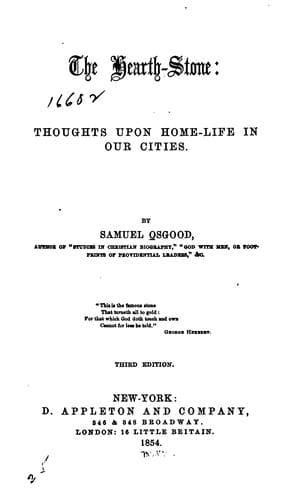
The Hearth-Stone: Thoughts Upon Home-Life in Our CitiesOsgood, Samuel
Religion
The Hearth-Stone: Thoughts Upon Home-Life in Our Cities
Osgood, Samuel
Christian life; Conduct of life
It would not be difficult to show the happy influence of familiarity with
the country in teaching lessons of virtue--in bracing the frame for
hardier labors--in urging the worth of the lesser ethics of frugality and
economy, and the higher morals of true manliness and godliness. Virtue is
moral strength, and is taught in every school that strengthens the moral
energies. The genial air and simple habits of rural life favor manly
fortitude, and a manly spirit. Poor would be the future prospects of our
nation if they rested wholly with the dwarfed and fevered offspring of our
cities. Our people would ere long lose their place among the nations, and
would drop their heads in shame in comparison with men trained in hardy
sports and healthful labors, as the yeomanry and gentry of England.
Religion itself, which is the crown of true manliness, would languish if
there were no more check to vice and skepticism than the check, strong
indeed as it is, which metropolitan churches afford. How wonderfully the
power of faith among the peasants of La Vendee withstood the sneers and
threats of Paris, with its armed bands of Atheists in the great
convulsion, when priests became scoffers and churches were places of
rioting! How nobly our own churches have been favored by the words and
thoughts of elect minds devoted to God and his truth, in peaceful villages
away from the crowded marts! Where would the pulpit find the teachers that
are needed, if its sole dependence were upon the youth reared in cities? I
could not but think much of the power of rural life in raising up vigorous
and independent preachers, whilst I was enjoying a few weeks of recreation
in the lovely town in which President Dwight prepared himself for his more
conspicuous ministry at New Haven. I have rambled with delight again and
again over that noble Greenfield Hill, which he celebrated in a poem, and
have not wondered that the vast and charming prospect, ranging as it does
from the broad waters of Long Island Sound to the peak of the Catskill
Mountains, should have made something of a poet of a theologian, sometimes
so remorseless a logician. May we not see, however, in his theological
works, and still more in the pages of his mighty predecessor in theology,
Edwards, of Northampton, who, too, dwelt among scenes of singular beauty,
ample proofs that nature never deserts her votaries, nor fails to breathe
into them a spirit of beauty, that can live, after the harsh dogmas have
perished like the husks that inclose the grain for the harvest.
Public-domain text, read in full here on John Shaqi.
Reviews
Reviews
No reviews yet
Be the first to share your thoughts on this work.
Elsewhere in the archive
Join the Discussion
Join the discussion
Sign in to leave a comment or review.
Sign InorCreate an account