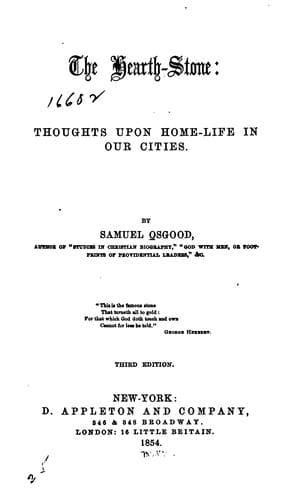
The Hearth-Stone: Thoughts Upon Home-Life in Our CitiesOsgood, Samuel
Religion
The Hearth-Stone: Thoughts Upon Home-Life in Our Cities
Osgood, Samuel
Christian life; Conduct of life
Speaking thus, who of us does not see a startling thought staring us in
the face--the thought that our own personal character is the measure of
our influence, and that we cannot expect to teach or impress what we have
not taken to our own hearts. We cannot cheat our children into the virtue
which we affect, for they will find us out, and distinguish what we do and
are, from what we say. Influence cannot rise above the level of character,
nor the fountain above the fountain-head. What motive to a truer
life--what warning against vice and godlessness--what encouragement in all
good--that the chief patrimony of children is the character of their
parents, and with this treasure small gifts are wealth, and without this
treasure rich gifts are poor indeed. Unhappy is the man who leaves to his
children the influence of a heart hard as stone and a worldliness wily as
a serpent! Precious the influence--blessed the memory of a parent, whose
life has made the ways of wisdom pleasant and peaceful, secured to his
offspring a childhood pure and happy, given a sacred and cheerful
remembrance to be the handmaid of an immortal hope.
The affections, it has been said, press downward more strongly than they
rise upward, and parents love their children more than children can love
them in return. If this were so, it would but the more illustrate the
fact, that life is not utterly selfish, and men live not for themselves
alone. It is true, that we do not live for ourselves alone. The merchant
at his counting-houses has thoughts beyond his gold and
merchandize--visions more fair and kindly than these; and the hard-handed
workman who does his ruder labor, spares of his earnings for his children
at school. But the love is not all on one side, although time may be
needed to adjust the balance, and teach childhood to appreciate a true
parental care. God holds the balance, and will make it true. In the motive
and in the result, he secures the reward of fidelity. Time and eternity
will show, that the love which he has inspired shall win harvests of
blessings that cannot perish.
Reverence in Children.
REVERENCE IN CHILDREN.
The Ten Commandments, the foundations of all law, both religious and
civil, among civilized nations, are divided, all are aware, into two
tables: the first treating of duties relating directly to God--the second
treating of duties relating to man--the two covering the essential grounds
of religion and morals. The command to honor father and mother begins the
second table of the Law. Why should it not? for what so fitly stands at
the head of the moral code, as the law that puts order into the household?
The family is the form of government, first in time and first in
importance. Home is older than church or court; a parent's authority prior
to that of priest or judge. With the family, social order began--without
family union, social order must end.
Public-domain text, read in full here on John Shaqi.
Reviews
Reviews
No reviews yet
Be the first to share your thoughts on this work.
Join the Discussion
Join the discussion
Sign in to leave a comment or review.
Sign InorCreate an account