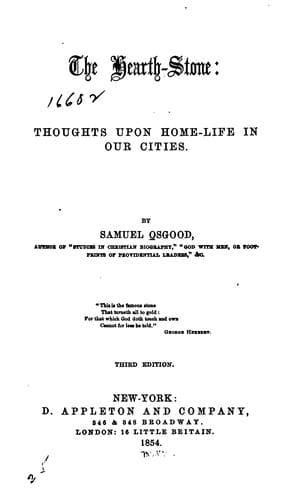
The Hearth-Stone: Thoughts Upon Home-Life in Our CitiesOsgood, Samuel
Religion
The Hearth-Stone: Thoughts Upon Home-Life in Our Cities
Osgood, Samuel
Christian life; Conduct of life
There is something striking in the transition from the first to the second
table--the transition from Jehovah's assertion of his own sovereignty to
his tender regard for the welfare of men. We seem to be looking down from
the awful mountain with its barren crags into the peaceful valley with its
pleasant homes and grassy lawns, rejoicing that the summits pealing with
thunder send down refreshing breezes and fruitful showers into those
plains below.
Looking up to God, who claims of us supreme homage as his due, and then in
his own sovereign right urges upon us to fulfil our dues to each other, we
speak now of the duties of children or the honor to be rendered by them to
parents.
* * * * *
Do any ask what are the grounds of the Commandments? The grounds are
obvious, and the law, which God enacts, instead of being an arbitrary
decree, is in entire harmony with the nature of things. It would perhaps
be needless to dwell on these grounds, were there not something in the
temper of our times, that calls them in question--in fact, certain notions
of intellectual liberty among theorists, that combine with the passions
and caprices of youth to unsettle many a household, and threaten the peace
of society itself. Against the sentimentalist, who makes light of all
natural ties to glorify the individual's own intuitions or affinities, and
against the little rebel, who comes to the same conclusion by a much
shorter process, we urge the Divine law, "Honor thy father and thy
mother."
Honor them, because God bids it, and bids it not merely in the written
code, but by the whole order of his providence, by the very constitution
of society. However we may dispute about the best form or true foundation
of government--maintain monarchy, aristocracy, or democracy, to be the
best form--declare Divine law, social compact, or popular will, to be the
true foundation, all must agree in the Divine origin of the family and
the Divine right of parental government. The instincts of nature, the
words of revelation, the dictates of experience and expediency, all agree
in this, and all illustrate the mind of God, the Creator of the family.
The mind of God himself speaks or should speak through the parent to the
child, so, that filial obedience is fitly another name for piety; so, that
prayer itself borrows its most hallowed word from the reverence nurtured
at home.
Public-domain text, read in full here on John Shaqi.
Reviews
Reviews
No reviews yet
Be the first to share your thoughts on this work.
Join the Discussion
Join the discussion
Sign in to leave a comment or review.
Sign InorCreate an account