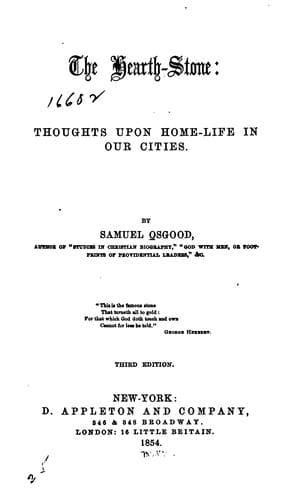
The Hearth-Stone: Thoughts Upon Home-Life in Our CitiesOsgood, Samuel
Religion
The Hearth-Stone: Thoughts Upon Home-Life in Our Cities
Osgood, Samuel
Christian life; Conduct of life
But to come more closely to the point, is it not true that proper respect
for parents urges the duty now under consideration and just filial love
must needs be fraternal? Children cannot be true to their parents without
being true to each other, and the welfare and charm of the household
depends in no small degree upon the mutual help and moral harmony of its
younger members. Children are not regarded as so many separate units, but
as an organic whole, as members one of another; and when they are
considerate and harmonious, they have new grace and worth in the parent's
eye, more so to his heart, than the features of the fairest landscape
where the particulars combine in the whole, and light, shade, grove and
river, hill and valley--fair in themselves, are fairer together, can
possibly have to the eye of the lover of nature. What under the heavens is
more pleasant and lovely than brethren who with all their differences of
taste and temperament still agree in aim and spirit? It is indeed like the
dew of Hermon, that threw its silver veil over mountain and valley, and
refreshed and beautified each tree and flower with a baptism from heaven.
But this relation of fraternal love to filial is but one of its aspects.
Brothers and sisters are related by what they owe directly to each other,
as well as by what they owe to parents. The will of God, that bids them
agree for their parents' sake, bids them also agree for their own sake.
Mutual educators of each other they must be, and by means far more
powerful than school-books or lessons. They are constantly together, and
this intercourse must be a selfish collision, if it be not a friendly
reciprocity. In childhood, they must needs be frequent rivals for the
favors and duties of the home, subjects of indulgences or sacrifices, that
must awaken strife, unless they are shared in mutual deference. With
childhood, however, the relation does not end, but may have in mature
years its gravest importance, for in the order of nature parents are
likely to be first taken from the world, and to all human view they may be
beyond the reach of kindness or unkindness. But the relation of children
to each other promises to last far longer, may create between the elder
and younger a relation parental as well as filial, and for good or ill it
must in some way continue as long as life itself. How essential, then,
that a tie so enduring should be rightly regarded, and that in childhood,
youth and maturity, it should keep its benignant hold over the family!
Public-domain text, read in full here on John Shaqi.
Reviews
Reviews
No reviews yet
Be the first to share your thoughts on this work.
Elsewhere in the archive
Join the Discussion
Join the discussion
Sign in to leave a comment or review.
Sign InorCreate an account