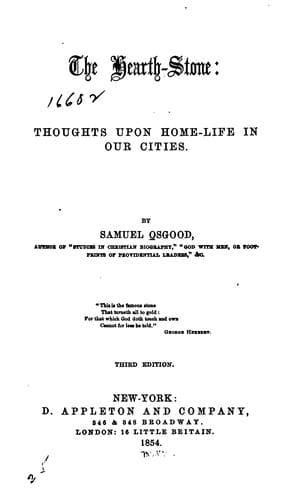
The Hearth-Stone: Thoughts Upon Home-Life in Our CitiesOsgood, Samuel
Religion
The Hearth-Stone: Thoughts Upon Home-Life in Our Cities
Osgood, Samuel
Christian life; Conduct of life
Nor does its importance end here. The method of God is, that the
affections shall grow outward from within, and that being trained in
kindness at home, men should be prepared to show good will to each other
in all the concerns of life. As the patriarchal dispensation, in the grand
course of ages, widened into the universality of the gospel, so in every
true life, a just family culture is to expand into a generous humanity,
that learns at home how to speak of a broader brotherhood, and a higher
fatherhood. Whether God's method is not wiser than man's let experience
show by contracting the windy declamation, that mistakes rhetorical
generalities for comprehensive benevolence, and the judicious,
unostentatious beneficence that carries out in all its relations the sober
good will cherished in a wholesome household discipline, and so on a true
pattern strives to build up the larger household of faith. The one begins
at the root, and so branches out in blessing--the other would begin with
the branches, which wither away when parted from the root.
* * * * *
So then in the will of God, revealed in the constitution of the family,
the welfare of its members, the spirit of humanity, we find the foundation
of the duties of brothers and sisters. The fraternal sentiment must be in
accordance. In all our affections, there must needs be some lights and
shades that depend upon the individual's gifts and experience, for no man
is a rule for all, and we must differ in our likings as in our looks. Yet
all primal obligations have essential features in common; and the
fraternal sentiment, although less instructive than the parental, and more
complex than the filial, has quite as decidedly a character of its own.
The phrenologist may not locate it in a special organ of the brain, and
the metaphysician may not make of it an instinct by itself, but it has its
root none the less in nature, and loses no interest from expanding so
generously under true associations and culture. When true, the fraternal
sentiment unites congeniality with consanguinity, and developes friendship
from kindred blood, as the parted branches open into leaves, and
blossoms, and fruits, kindred in their aims as their source. Its nature is
better shown by tracing out its just influence than by attempting to
arrest its flitting shades of hue, or to analyze its constituent elements.
Here, too, is the practical bearing of the subject, a bearing which many
slight far more from thoughtlessness than from indifference. In what light
are brothers or sisters called to regard each other?
Public-domain text, read in full here on John Shaqi.
Reviews
Reviews
No reviews yet
Be the first to share your thoughts on this work.
Elsewhere in the archive
Join the Discussion
Join the discussion
Sign in to leave a comment or review.
Sign InorCreate an account