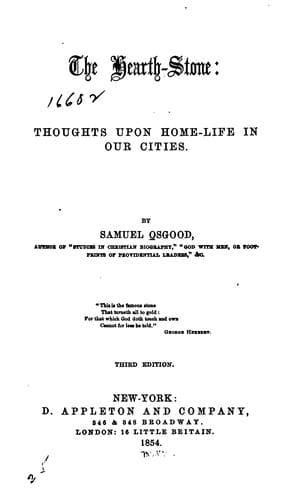
The Hearth-Stone: Thoughts Upon Home-Life in Our CitiesOsgood, Samuel
Religion
The Hearth-Stone: Thoughts Upon Home-Life in Our Cities
Osgood, Samuel
Christian life; Conduct of life
Their first obvious duty is that of due consideration for each other. They
are to consider each other's circumstances, needs, trials, dispositions,
opportunities, and never allow selfishness or indifference to blind them
to what belongs to them in common. Does this need to be said of persons
who are so near, as of necessity to be always in each other's thoughts?
Ah, what is more frequent and obvious, than that familiarity tempts
indifference, and that our very primal duties, like the stars which are
their emblems, are easily forgotten because they may at any time be seen?
The things most significant are likely to be near at hand, and religion,
like philosophy, finds its chief triumphs in opening the meaning of what
God has brought to our very door. A part of the power of absence from home
lies in breaking the spell of familiarity, and leading the absent one to
look impartially upon the familiar circle, and upon his own place and
conduct there. Many a youth or maiden has returned from a journey or
voyage wiser far in sense of home duties than proud of the accomplishments
of travel. True consideration will not need absence to teach this lesson,
but from its calm point of view the absent one will survey the common
spheres of life, and try to live for others as under the eye of God.
In each family there will be decided need for mutual consideration, and
there must be strife, unless there is mutual deference. All cannot have
all the favors, and the division of them may embroil a household as
bitterly as the division of an empire has embroiled rival heirs of
thrones. Where means are limited, mutual sacrifices not always easy must
be made, and few families pass many years without feeling the power of
consideration, or of selfishness in meeting the privations that must go
round their circle. When means are abundant, and every wish has ready
wealth at its command, the form of forbearance may change, but its
essential spirit is none the less needed. There will still be differences
of talent, looks, manners, opportunities, health, experience, that require
in the most prosperous household the same virtues, that give the humblest
cottage its dignity and peace. In every family, there will be some call
for peculiar consideration or regard to some member of it, according as
sickness, infirmity, youth, age, deficient or extraordinary ability, may
call upon the stronger to serve the weaker. What wretchedness when the
call is slighted, even by one! Who can calculate the mischief wrought by a
sensual or reckless brother, who makes every thing secondary to his own
passions and pleasures, or by a frivolous and heartless sister, who makes
a god of fashion and enslaves the whole house to her monstrous vanity!
Who, too, can calculate the influence of a high-minded brother in guiding
and cheering the younger members of the family, or of a devoted and
judicious sister in soothing every impatient humor with a face in which
Public-domain text, read in full here on John Shaqi.
Reviews
Reviews
No reviews yet
Be the first to share your thoughts on this work.
Elsewhere in the archive
Join the Discussion
Join the discussion
Sign in to leave a comment or review.
Sign InorCreate an account