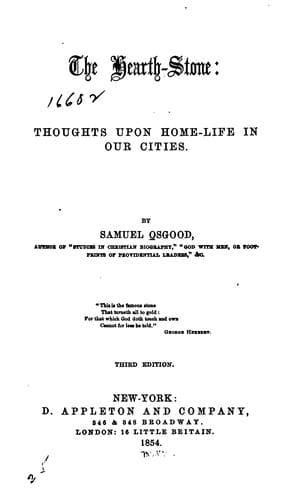
The Hearth-Stone: Thoughts Upon Home-Life in Our CitiesOsgood, Samuel
Religion
The Hearth-Stone: Thoughts Upon Home-Life in Our Cities
Osgood, Samuel
Christian life; Conduct of life
Let all apply these thoughts. Children, apply them, and be kind in all you
do and say. Youth, apply them, and be thoughtful where you are often
tempted to be reckless. Elders, apply them, and never allow care or
worldliness to chill the better affections of early days. Deep in the
heart let the old home live, and its pleasant memories, brightened by
kindly offices, open ever into immortal hopes. Old things must pass away,
but from the Christian they can only pass away by being all made new--new
in a spirit, that remembers best when progressing most, and crowns all
friendships with charity divine.
Marriage.
MARRIAGE.
It is a remarkable fact, that He who came to be the Saviour from sin,
whose name is coupled with the sorrow that he would alleviate, began his
public ministry at a marriage, and gave the first proof of his powers
amidst its festivities. Yet why wonder at it--for where should the Gospel
begin its work if not with the union that founds the family and should
secure every social and moral good? How, moreover, could the genius of
Christianity better show itself than by such a practical rebuke of the
asceticism that scorned the social affections, and would make of life a
ghostly austerity, just as if man were heavenly by being unearthly? It
needs no great ingenuity to imagine our Lord's feelings, as with his
kindly and majestic thought he looked upon that scene, and gave his
blessing to the youth and maiden who were probably of his own kin. He saw
all the serious and trying aspects of human life even in its best estate,
yet none the less gave them joy upon their union.
It is well that he was at that feast. The ages since have remembered his
presence, and his sacred name, heard still at the marriage, deepens its
memory, and consecrates its joy. The two ideas thus connected in fact are
connected in principle, and the moralist need not in any enlightened
community fear to speak of the Christian view of marriage, or care at all
either for the giggling levity that sees nothing solemn in the subject, or
for the sanctimonious gravity, that considers religion profaned by being
made practical. There are some difficulties in the way of a frank
treatment of the subject; I know our customs do not favor the homely
simplicity of the language of the Bible in the discussion of marriage, and
he must be very adventurous who undertakes to use the plain speech of the
old divines, whether in the quaint aphorisms of Thomas Fuller or the
jewelled periods of Jeremy Taylor. Yet it is not well to be very
fastidious or mystify any subject by ingenious circumlocution, and we
propose to say some plain words on the relation of husbands and wives in
continuation of these thoughts upon home duties.
* * * * *
Not much need be said upon the foundation of this relation. It rests
clearly upon the will of God, the best good of the parties, and the
welfare of society.
Public-domain text, read in full here on John Shaqi.
Reviews
Reviews
No reviews yet
Be the first to share your thoughts on this work.
Elsewhere in the archive
Join the Discussion
Join the discussion
Sign in to leave a comment or review.
Sign InorCreate an account