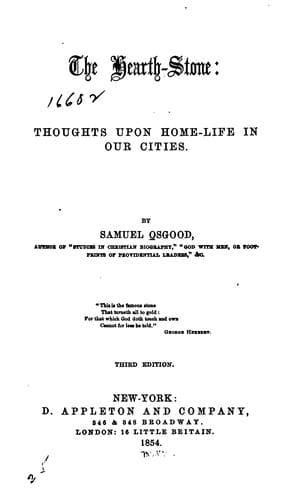
The Hearth-Stone: Thoughts Upon Home-Life in Our CitiesOsgood, Samuel
Religion
The Hearth-Stone: Thoughts Upon Home-Life in Our Cities
Osgood, Samuel
Christian life; Conduct of life
"For woman is not undeveloped man,
But diverse; could we make her as the man,
Sweet love were slain, whose dearest bond is this
Not like to thee, but like in difference;
Yet in the long years liker must they grow;
The man be more of woman, she of man;
He gain in sweetness and in moral height,
Nor lose the wrestling thews that throw the world;
She mental breath, nor fail in childward care:
More as the double-natured Poet each:
Till at the last she set herself to man,
Like perfect music unto noble words;
And so these twain, upon the skirts of Time,
Sit side by side, full-summed in all their powers,
Dispensing harvest, sowing the To-be,
Self-reverent each and reverencing each,
Distinct in individualities,
But like each other even as those who love.
Then comes the statelier Eden back to men:
Then reign the world's great bridals, chaste and calm:
Then springs the crowning race of humankind."
"It is the worst clandestine marriage," said old Thomas Fuller, "when God
is not invited to it, wherefore, beforehand beg his gracious assistance."
Equally bad, we add, is the marriage, where His presence is not retained,
and they who at first sought His blessing do not hold to it ever to keep
them true and thoughtful, to lift them into a union to which the Beloved
Son was not ashamed to compare His own communion with souls. Perfection on
earth we may not ask, nor call a hasty word or impatient thought
unpardonable. They who love much must expect to forgive something and
forbear sometimes. But this may be expected and is demanded, that they who
take each other's welfare in charge should never do any intentional
unkindness, or fail of aught that may be done for the other's welfare.
This may be expected and is demanded, that when the tie that binds them is
severed by the only power that can fitly part them, and they are to part
at death--they should look back with mutual blessing to the hour of their
first union, be assured that through all vicissitudes and infirmities,
they have tried to make each other better and happier, and that they have
learned of Him whose name at their Cana made their wedding sacred, to
trust in the realm where they neither marry nor are given in marriage, but
are as the angels of God.
Public-domain text, read in full here on John Shaqi.
Reviews
Reviews
No reviews yet
Be the first to share your thoughts on this work.
Elsewhere in the archive
Join the Discussion
Join the discussion
Sign in to leave a comment or review.
Sign InorCreate an account