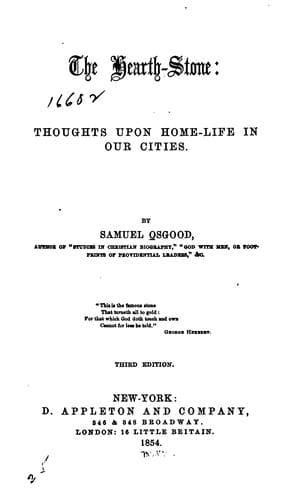
The Hearth-Stone: Thoughts Upon Home-Life in Our CitiesOsgood, Samuel
Religion
The Hearth-Stone: Thoughts Upon Home-Life in Our Cities
Osgood, Samuel
Christian life; Conduct of life
Do we think enough of this whole subject of companionship--enough of it
for ourselves and our children? In some way, perhaps, we may think enough
of being in society, and we may have a sharp eye on our list of
acquaintance, be eager enough for the silly race of ostentatious eating,
drinking, and dressing, that is the life of our semi-barbarous fashion, or
for the frivolous social circles, where friendship is part of the play,
and they who flatter each other to the face, laugh at each other as soon
as the back is turned; and in perhaps honeyed words character is depicted
as sharply as if cannibals had but changed their policy, and brought their
teeth to bear in a different way, not upon the flesh but upon the life.
Perhaps we have a better ambition, and desire for ourselves and our
children the society of the refined, and wise, and good. This is well, but
one point must not be overlooked. There is no getting into really good
society but by growing into it. We may win entrance to the houses and
tables of distinguished people perhaps, but our real friendship with
persons of sterling character must depend on our character and culture.
Ask honestly--what are we, what have we made and are making of ourselves
and our children? And our worth will be the precise measure of the
friendship we deserve and are likely to have. Here is motive for the best
culture of the mind and heart. A man's own essential character--what he
thinks, knows, is, and can do,--it is this that opens to him true
companionship, and by a law as universal as that of specific gravity, he
rises or falls to his own level. Is it not worth a life's effort to be
worthy to win and enjoy the intimate companionship of choice minds?
Do we think of this in the training of our children? Do we try to educate
their social affections morally and intellectually--strive to make our
houses attractive to sensible people, to give our sons distaste for
profligates, and our daughters disgust for fops and fools? Are we laying
the foundations of sincere and elevating relations that shall put the due
check upon the evil communications that so corrupt good manners? If not,
think seriously of the neglect, and do better, as you fear God and love
the best in the life he has given us.
Public-domain text, read in full here on John Shaqi.
Reviews
Reviews
No reviews yet
Be the first to share your thoughts on this work.
Elsewhere in the archive
Join the Discussion
Join the discussion
Sign in to leave a comment or review.
Sign InorCreate an account