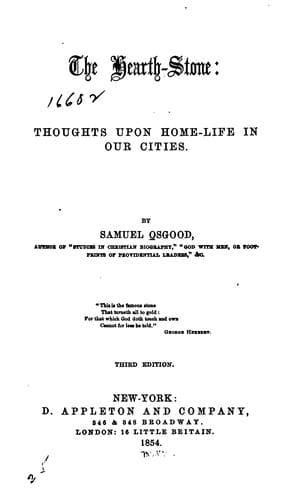
The Hearth-Stone: Thoughts Upon Home-Life in Our CitiesOsgood, Samuel
Religion
The Hearth-Stone: Thoughts Upon Home-Life in Our Cities
Osgood, Samuel
Christian life; Conduct of life
Limitation of means is borne with equanimity, and developes new energies
instead of breaking down the spirits. Enlarged fortune widens the sphere
of beneficence, and repeats the Publican's vow in some way: "Lord, the
half of my goods I give to the poor; and if I have taken any thing from
any man by false accusation, I restore him fourfold." New jubilee of
justice and generosity would it not be, if true guidance of the households
of Christendom could train desires and purposes, such as sprung up in that
man's heart whilst Jesus of Nazareth dwelt in his home. We know not all
that transpired in the interview between this kindly host, and his Divine
guest; but the conclusion leads us to believe that the conversation turned
less upon the forms of ceremony and degrees of belief, than upon practical
righteousness, such as appeared impressed so mightily upon the heart of
Zaccheus in making his declaration of the worth of justice and mercy. How
many households would at once stop their folly and extravagance, and open
their eyes to the solemn realities of life, if the Divine guest were to be
sought in such a spirit.
As to the precise form in which Christianity should be acknowledged in the
family, we do not propose to lay down any minute, much less any arbitrary
rules. The great thing is to cherish a sense of God's presence, and
providence, and rule the spirit in the piety and charity which he
approves. The stated recognition of his authority we urge ever, and the
desirableness of regular use of the scriptures, and prayer daily in the
home. If there be fear of routine and indifference, let a true purpose
overcome that, and prove that the most thorough habit comports with, nay
favors, the highest freedom, and the soul, like the body, is not shackled
by an accustomed method of nurture. Of course, no round of ceremonials can
be any substitute for living religion; and there is proof enough, that the
most rigid routine of lip service may co-exist with the utmost asperity
and worldliness. Tokens, alas, there are sometimes, that what passes for
piety may bring no Christian graces to the dwelling; and some bigot, who
mistakes hatred of the world for godliness, or some flaunting modist, who
has adopted a church as a fashion, may bring churlishness or conceit in
sheep's clothing into the house. These, and all such shams, make true
religion more beautiful, and lend new attraction to the page which records
the visit of Christ to a dwelling which the scowling Pharisee scorned, but
which the love of God so richly blessed.
Public-domain text, read in full here on John Shaqi.
Reviews
Reviews
No reviews yet
Be the first to share your thoughts on this work.
Elsewhere in the archive
Join the Discussion
Join the discussion
Sign in to leave a comment or review.
Sign InorCreate an account