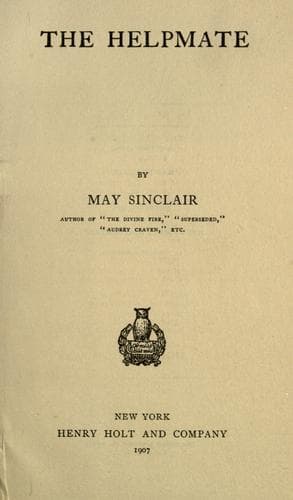
Somehow she had managed so that, as long as he was with her, shame was
impossible for himself or her. As long as he was with her he was wrapped
in her illusion, the illusion of innocence, of happiness, of all the
unspoken sanctities of home. He knew that whether he was or was not with
her, as long as he loved her no other man would come between him and her;
no other man would cross his threshold and stand upon his hearth. The
house he came to was holy to her. There were times, so deep was the
illusion, when he could have believed that Maggie, sitting there at his
feet, was the pure spouse, the helpmate, and Anne, in the house in Prior
Street, the unwedded, unacknowledged mistress, the distant, the secret,
the forbidden. He had never disguised from Maggie the temporary and
partial nature of the tie that bound them. But the illusion was too
strong for both of them. It was strong upon him now.
The woman, Mrs. Pearson, came in with supper, moving round the room in
silence, devoted and discreet.
Majendie was hungry. Maggie was unable to conceal her frank joy in seeing
him eat and drink. She ate little and talked a great deal, drawn by his
questions.
"What have you been doing, Maggie?"
Maggie gave an account of her innocent days, of her labours in house and
farm and garden. She loved all three, she loved her flowers and her
chickens and her rabbits, and the little young pigs. She loved all things
that had life. She was proud of her house. Her hands were always busy in
it. She had stitched all the linen for it. She had made all the
tablecloths, sofa covers and curtains, and given to them embroidered
borders. She liked to move about among all these beautiful things and
feel that they were hers. But she loved those most which Majendie had
used, or noticed, or admired. After supper she took up her old position
by his chair.
"How long can you stay?" said she.
"I must go to-morrow."
"Oh, why?"
"I've told you why, dear. It's my little girl's birthday to-morrow."
She remembered.
"Her birthday. How old will she be to-morrow?"
"Seven."
"Seven. What does she do all day long?"
"Oh, she amuses herself. We have a garden."
"How she would love this garden, and the flowers, and the swing, and the
chickens, and all the animals, wouldn't she?"
"Yes. Yes."
Somehow he didn't like Maggie to talk about his child, but he hadn't the
heart to stop her.
"Is she as pretty as she was?"
"Prettier."
"And she's not a bit like you."
"Not a bit, not a little bit."
"I'm glad," said Maggie.
"Why on earth are you glad?"
"Because--I couldn't bear _her_ child to be like you."
"You mustn't say those things, Maggie, I don't like it."
"I won't say them. You don't mind my thinking them, do you? I can't help
thinking."
She thought for a long time; then she got up, and came to him, and put
her arm round his neck, and bowed her head and whispered.
"Don't whisper. I hate it. Speak out. Say what you've got to say."
"I can't say it."
She said it very low.
Public-domain text, read in full here on John Shaqi.
Reviews
Reviews
No reviews yet
Be the first to share your thoughts on this work.
Elsewhere in the archive
Join the Discussion
Join the discussion
Sign in to leave a comment or review.
Sign InorCreate an account