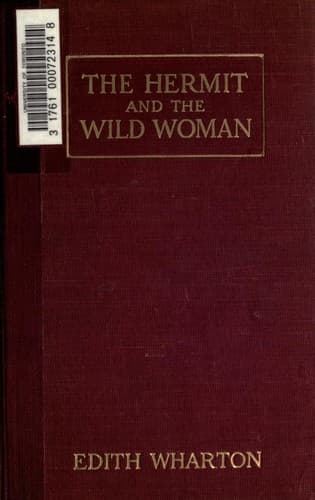
The Hermit and the Wild Woman, and Other StoriesWharton, Edith
General
The Hermit and the Wild Woman, and Other Stories
Wharton, Edith
Short stories, American
Mr. Mungold, freshly soaped and scented, with a neat glaze of gentility
extending from his varnished boot-tips to his glossy hat, looked like
the "flattered" portrait of a common man--just such an idealized
presentment as his own brush might have produced. As a rule, however,
he devoted himself to the portrayal of the other sex, painting ladies
in syrup, as Arran said, with marsh-mallow children leaning against
their knees. He was as quick as a dressmaker at catching new ideas, and
the style of his pictures changed as rapidly as that of the
fashion-plates. One year all his sitters were done on oval canvases,
with gauzy draperies and a background of clouds; the next they were
seated under an immemorial elm, caressing enormous dogs obviously
constructed out of door-mats. Whatever their occupation they always
looked straight out of the canvas, giving the impression that their
eyes were fixed on an invisible camera. This gave rise to the rumour
that Mungold "did" his portraits from photographs; it was even said
that he had invented a way of transferring an enlarged photograph to
the canvas, so that all that remained was to fill in the colours. If he
heard of this charge he took it calmly, but probably it had not reached
the high spheres in which he moved, and in which he was esteemed for
painting pearls better, and making unsuggestive children look lovelier,
than any of his fellow-craftsmen. Mr. Mungold, in fact, deemed it a
part of his professional duty to study his sitters in their home-life;
and as this life was chiefly led in the homes of others, he was too
busy dining out and going to the opera to mingle much with his
colleagues. But as no one is wholly consistent, Mr. Mungold had lately
belied his ambitions by falling in love with Kate Arran; and with that
gentle persistency which made him so wonderful in managing obstreperous
infantile sitters, he had contrived to establish a precarious footing
in her brother's studio.
Part of his success was due to the fact that he could not easily think
himself the object of a rebuff. If it seemed to hit him he regarded it
as deflected from its aim, and brushed it aside with a discreet
gesture. A touch of comedy was lent to the situation by the fact that,
till Kate Arran's coming, Mungold had always served as her brother's
Awful Example. It was a mark of Arran's lack of humour that he
persisted in regarding the little man as a conscious apostate, instead
of perceiving that he painted as he could, in a world which really
looked to him like a vast confectioner's window. Stanwell had never
quite divined how Mungold had won over the sister, to whom her
brother's prejudices were a religion; but he suspected the painter of
having united a deep belief in Caspar's gifts with the occasional offer
of opportune delicacies--the port-wine or game which Kate had no other
means of procuring for her patient.
Public-domain text, read in full here on John Shaqi.
Reviews
Reviews
No reviews yet
Be the first to share your thoughts on this work.
Elsewhere in the archive
Join the Discussion
Join the discussion
Sign in to leave a comment or review.
Sign InorCreate an account