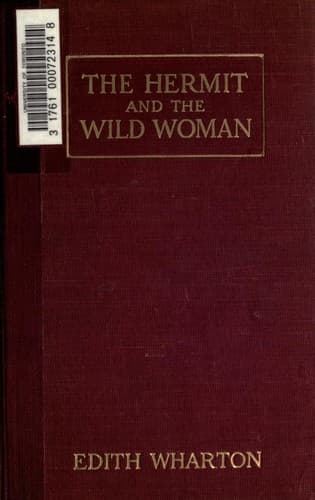
The Hermit and the Wild Woman, and Other StoriesWharton, Edith
General
The Hermit and the Wild Woman, and Other Stories
Wharton, Edith
Short stories, American
The picture produced a different and less flattering effect on the
critics. They gave it, indeed, more space than they had ever before
accorded to the artist's efforts, but their estimate seemed to confirm
Caspar Arran's forebodings, and Stanwell had perhaps never despised
them so little as when he read their comments on his work. On the
whole, however, neither praise nor blame disquieted him greatly. He was
engrossed in the contemplation of Kate Arran's happiness, and basking
in the refracted warmth it shed about her. The doctor's
prognostications had come true. Caspar was putting on a pound a week,
and had plunged into a fresh "creation" more symbolic and encumbering
than the monument of which he had been so opportunely relieved. If
there was any cloud on Stanwell's enjoyment of life, it was caused by
the discovery that success had quadrupled Caspar's artistic energies.
Meanwhile it was delightful to see Kate's joy in her brother's
recovered capacity for work, and to listen to the axioms which, for
Stanwell's guidance, she deduced from the example of Caspar's heroic
pursuit of the ideal. There was nothing repellent in Kate's borrowed
didacticism, and if it sometimes bored Stanwell to hear her quote her
brother, he was sure it would never bore him to be quoted by her
himself; and there were moments when he felt he had nearly achieved
that distinction.
Caspar was not addicted to the visiting of art exhibitions. He took
little interest in any productions save his own, and was moreover
disposed to believe that good pictures, like clever criminals, are apt
to go unhung. Stanwell therefore thought it unlikely that his portrait
of Mrs. Millington would be seen by Kate, who was not given to
independent explorations in the field of art; but one day, on entering
the exhibition--which he had hitherto rather nervously shunned--he saw
the Arrans at the end of the gallery in which the portrait hung. They
were not looking at it, they were moving away from it, and to
Stanwell's quickened perceptions their attitude seemed almost that of
flight. For a moment he thought of flying too; then a desperate resolve
nerved him to meet them, and stemming the crowd, he made a circuit
which brought him face to face with their retreat.
The room in which they met was momentarily empty, and there was nothing
to intervene between the shock of their inter-changed glances. Caspar
was flushed and bristling: his little body quivered like a machine from
which the steam has just been turned off. Kate lifted a stricken
glance. Stanwell read in it the reflexion of her brother's tirade, but
she held out her hand in silence.
For a moment Caspar was silent too; then, with a terrible smile: "My
dear fellow, I congratulate you; Mungold will have to look to his
laurels," he said.
The shot delivered, he stalked away with his seven-league stride, and
Kate moved tragically through the room in his wake.
V
SHEPSON took up his hat with a despairing gesture.
Public-domain text, read in full here on John Shaqi.
Reviews
Reviews
No reviews yet
Be the first to share your thoughts on this work.
Elsewhere in the archive
Join the Discussion
Join the discussion
Sign in to leave a comment or review.
Sign InorCreate an account