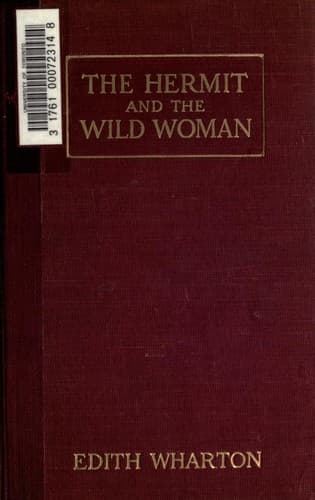
The Hermit and the Wild Woman, and Other StoriesWharton, Edith
General
The Hermit and the Wild Woman, and Other Stories
Wharton, Edith
Short stories, American
But though Dawnish continued to write, with all the English loyalty to
the outward observances of friendship, his communications came only at
intervals of several weeks, and between them she had time to repossess
herself, to regain some sort of normal contact with life. And the
customary, the recurring, gradually reclaimed her, the net of habit
tightened again--her daily life became real, and her one momentary
escape from it an exquisite illusion. Not that she ceased to believe in
the miracle that had befallen her: she still treasured the reality of
her one moment beside the river. What reason was there for doubting it?
She could hear the ring of truth in young Dawnish's voice: "It's not my
fault if you've made me feel that you would understand everything...."
No! she believed in her miracle, and the belief sweetened and illumined
her life; but she came to see that what was for her the transformation
of her whole being might well have been, for her companion, a mere
passing explosion of gratitude, of boyish good-fellowship touched with
the pang of leave-taking. She even reached the point of telling herself
that it was "better so": this view of the episode so defended it from
the alternating extremes of self-reproach and derision, so enshrined it
in a pale immortality to which she could make her secret pilgrimages
without reproach.
For a long time she had not been able to pass by the bench under the
willows--she even avoided the elm walk till autumn had stripped its
branches. But every day, now, she noted a step toward recovery; and at
last a day came when, walking along the river, she said to herself, as
she approached the bench: "I used not to be able to pass here without
thinking of him; _and now I am not thinking of him at all!_"
This seemed such convincing proof of her recovery that she began, as
spring returned, to permit herself, now and then, a quiet session on
the bench--a dedicated hour from which she went back fortified to her
task.
She had not heard from her friend for six weeks or more--the intervals
between his letters were growing longer. But that was "best" too, and
she was not anxious, for she knew he had obtained the post he had been
preparing for, and that his active life in London had begun. The
thought reminded her, one mild March day, that in leaving the house she
had thrust in her reticule a letter from a Wentworth friend who was
abroad on a holiday. The envelope bore the London post mark, a fact
showing that the lady's face was turned toward home. Margaret seated
herself on her bench, and drawing out the letter began to read it.
The London described was that of shops and museums--as remote as
possible from the setting of Guy Dawnish's existence. But suddenly
Margaret's eye fell on his name, and the page began to tremble in her
hands.
Public-domain text, read in full here on John Shaqi.
Reviews
Reviews
No reviews yet
Be the first to share your thoughts on this work.
Elsewhere in the archive
Join the Discussion
Join the discussion
Sign in to leave a comment or review.
Sign InorCreate an account