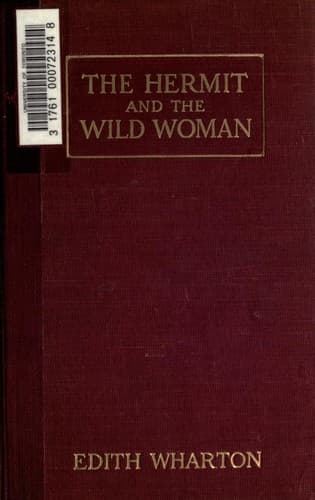
The Hermit and the Wild Woman, and Other StoriesWharton, Edith
General
The Hermit and the Wild Woman, and Other Stories
Wharton, Edith
Short stories, American
Nothing was changed in the setting of her life, perhaps nothing would
ever change in it. She would certainly live and die in Wentworth. And
meanwhile the days would go on as usual, bringing the usual
obligations. As the word flitted through her brain she remembered that
she had still to put the finishing touches to the paper she was to read
the next afternoon at the meeting of the Higher Thought Club.
The book she had been reading lay face downward beside her, where she
had left it an hour ago. She took it up, and slowly and painfully, like
a child laboriously spelling out the syllables, she went on with the
rest of the sentence:
--"and they spring from a level not much above that of the springing of
the transverse and diagonal ribs, which are so arranged as to give a
convex curve to the surface of the vaulting conoid."
THE VERDICT
I HAD always thought Jack Gisburn rather a cheap genius--though a good
fellow enough--so it was no great surprise to me to hear that, in the
height of his glory, he had dropped his painting, married a rich widow,
and established himself in a villa on the Riviera. (Though I rather
thought it would have been Rome or Florence.)
"The height of his glory"--that was what the women called it. I can
hear Mrs. Gideon Thwing--his last Chicago sitter--deploring his
unaccountable abdication. "Of course it's going to send the value of my
picture 'way up; but I don't think of that, Mr. Rickham--the loss to
Arrt is all I think of." The word, on Mrs. Thwing's lips, multiplied
its _rs_ as though they were reflected in an endless vista of mirrors.
And it was not only the Mrs. Thwings who mourned. Had not the exquisite
Hermia Croft, at the last Grafton Gallery show, stopped me before
Gisburn's "Moon-dancers" to say, with tears in her eyes: "We shall not
look upon its like again"?
Well!--even through the prism of Hermia's tears I felt able to face the
fact with equanimity. Poor Jack Gisburn! The women had made him--it was
fitting that they should mourn him. Among his own sex fewer regrets
were heard, and in his own trade hardly a murmur. Professional
jealousy? Perhaps. If it were, the honour of the craft was vindicated
by little Claude Nutley, who, in all good faith, brought out in the
Burlington a very handsome "obituary" on Jack--one of those showy
articles stocked with random technicalities that I have heard (I won't
say by whom) compared to Gisburn's painting. And so--his resolve being
apparently irrevocable--the discussion gradually died out, and, as Mrs.
Thwing had predicted, the price of "Gisburns" went up.
Public-domain text, read in full here on John Shaqi.
Reviews
Reviews
No reviews yet
Be the first to share your thoughts on this work.
Elsewhere in the archive
Join the Discussion
Join the discussion
Sign in to leave a comment or review.
Sign InorCreate an account