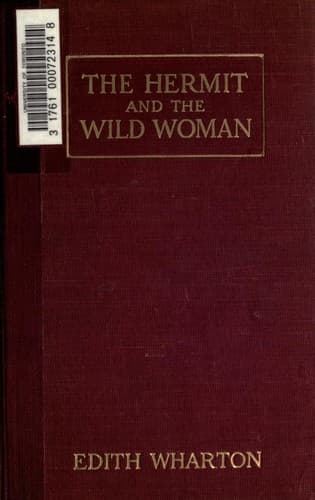
The Hermit and the Wild Woman, and Other StoriesWharton, Edith
General
The Hermit and the Wild Woman, and Other Stories
Wharton, Edith
Short stories, American
"By Jove, this is a little too much like the last act of _Boheme_," he
said, slipping into his coat again after a vain glance at the
coal-scuttle. Much solitude, and a lively habit of mind, had bred in
him the habit of audible soliloquy, and having flung a shout for the
janitor down the seven flights dividing the studio from the basement,
he turned back, picking up the thread of his monologue. "Exactly like
_Boheme_, really--that crack in the wall is much more like a
stage-crack than a real one--just the sort of crack Mungold would paint
if he were doing a Humble Interior."
Mungold, the fashionable portrait-painter of the hour, was the
favourite object of the younger men's irony.
"It only needs Kate Arran to be borne in dying," Stanwell continued
with a laugh. "Much more likely to be poor little Caspar, though," he
concluded.
His neighbour across the landing--the little sculptor, Caspar Arran,
humorously called "Gasper" on account of his bronchial asthma--had
lately been joined by a sister, Kate Arran, a strapping girl, fresh
from the country, who had installed herself in the little room off her
brother's studio, keeping house for him with a chafing-dish and a
coffee-machine, to the mirth and envy of the other young men in the
building.
Poor little Gasper had been very bad all the autumn, and it was
surmised that his sister's presence, which he spoke of growlingly, as a
troublesome necessity devolved on him by the inopportune death of an
aunt, was really an indication of his failing ability to take care of
himself. Kate Arran took his complaints with unfailing good-humour,
darned his socks, brushed his clothes, fed him with steaming broths and
foaming milk-punches, and listened with reverential assent to his
interminable disquisitions on art. Every one in the house was sorry for
little Gasper, and the other fellows liked him all the more because it
was so impossible to like his sculpture; but his talk was a bore, and
when his colleagues ran in to see him they were apt to keep a hand on
the door-knob and to plead a pressing engagement. At least they had
been till Kate came; but now they began to show a disposition to enter
and sit down. Caspar, who was no fool, perceived the change, and
perhaps detected its cause; at any rate, he showed no special
gratification at the increased cordiality of his friends, and Kate, who
followed him in everything, took this as a sign that guests were to be
discouraged.
Public-domain text, read in full here on John Shaqi.
Reviews
Reviews
No reviews yet
Be the first to share your thoughts on this work.
Elsewhere in the archive
Join the Discussion
Join the discussion
Sign in to leave a comment or review.
Sign InorCreate an account