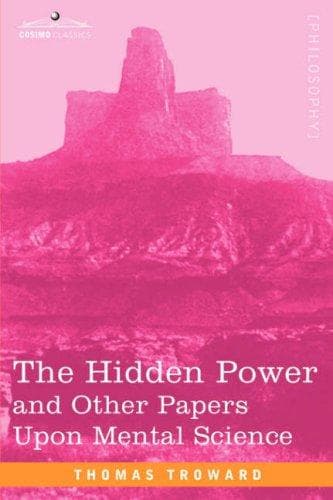
The Hidden Power, and Other Papers upon Mental ScienceTroward, T. (Thomas)
Religion
The Hidden Power, and Other Papers upon Mental Science
Troward, T. (Thomas)
New Thought
For if we do not recognise the Central Mind as the source of our
vitality, we are literally "fighting for our own hand," and all the
other hands are against us, for we have lost the principle of connection
with them. This is what must infallibly happen if we rely on nothing but
our individual will-power. But if we realise that the will is the power
by which we give out, and that every giving out implies a corresponding
taking in, then we shall find in the boundless ocean of central living
Spirit the source from which we can go on taking in _ad infinitum_, and
which thus enables us to give out to any extent we please. But for wise
and effective giving out a strong and enlightened will is an absolute
necessity, and therefore we do well to cultivate the will, or the active
side of our nature. But we must equally cultivate the receptive side
also; and when we do this rightly by seeing in the Infinite Mind the one
source of supply, our will-power becomes intensified by the knowledge
that the whole power of the Infinite is present to back it up; and with
this continual sense of Infinite Power behind us we can go calmly and
steadily to the accomplishment of any purpose, however difficult,
without straining or effort, knowing that it shall be achieved, not by
the hand only, but by the invincible Mind that works through it. "Not by
might, nor by power, but by My Spirit, saith the Lord of hosts."
1902.
XXIII
THE CENTRAL CONTROL
In contemplating the relations between body, soul, and spirit, between
Universal Mind and individual mind, the methodised study of which
constitutes Mental Science, we must never forget that these relations
indicate, not the separateness, but the unity of these principles. We
must learn not to attribute one part of our action to one part of our
being, and another to another. Neither the action nor the functions are
split up into separate parts. The action is a whole, and the being that
does it is a whole, and in the healthy organism the reciprocal movements
of the principles are so harmonious as never to suggest any feeling than
that of a perfectly whole and undivided self. If there is any other
feeling we may be sure that there is abnormal action somewhere, and we
should set ourselves to discover and remove the cause of it. The reason
for this is that in any perfect organism there cannot be more than one
centre of control.
Public-domain text, read in full here on John Shaqi.
Reviews
Reviews
No reviews yet
Be the first to share your thoughts on this work.
Elsewhere in the archive
Join the Discussion
Join the discussion
Sign in to leave a comment or review.
Sign InorCreate an account