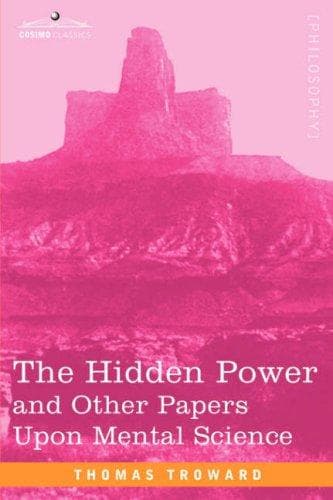
The Hidden Power, and Other Papers upon Mental ScienceTroward, T. (Thomas)
Religion
The Hidden Power, and Other Papers upon Mental Science
Troward, T. (Thomas)
New Thought
"Entering into the spirit of it." What a common expression! And yet how
much it really means, how absolutely everything! We enter into the
spirit of an undertaking, into the spirit of a movement, into the spirit
of an author, even into the spirit of a game; and it makes all the
difference both to us and to that into which we enter. A game without
any spirit is a poor affair; and association in which there is no spirit
falls to pieces; and a spiritless undertaking is sure to be a failure.
On the other hand, the book which is meaningless to the unsympathising
reader is full of life and suggestion to the one who enters into the
spirit of the writer; the man who enters into the spirit of the music
finds a spring of refreshment in some fine recital which is entirely
missed by the cold critic who comes only to judge according to the
standard of a rigid rule; and so on in every case that we can think of.
If we do not enter the spirit of a thing, it has no invigorating effect
upon us, and we regard it as dull, insipid and worthless. This is our
everyday experience, and these are the words in which we express it.
And the words are well chosen. They show our intuitive recognition of
the spirit as the fundamental reality in everything, however small or
however great. Let us be right as to the spirit of a thing, and
everything else will successfully follow.
By entering into the spirit of anything we establish a mutual vivifying
action and reaction between it and ourselves; we vivify it with our own
vitality, and it vivifies us with a living interest which we call its
spirit; and therefore the more fully we enter into the spirit of all
with which we are concerned, the more thoroughly do we become _alive_.
The more completely we do this the more we shall find that we are
penetrating into the great secret of Life. It may seem a truism, but the
great secret of Life is its Livingness, and it is just more of this
quality of Livingness that we want to get hold of; it is that good thing
of which we can never have too much.
But every fact implies also its negative, and we never properly
understand a thing until we not only know what it is, but also clearly
understand what it is not. To a complete understanding the knowledge of
the negative is as necessary as the knowledge of the affirmative; for
the perfect knowledge consists in realising the relation between the
two, and the perfect power grows out of this knowledge by enabling us to
balance the affirmative and negative against each other in any
proportion that we will, thus giving flexibility to what would otherwise
be too rigid, and form to what would otherwise be too fluid; and so, by
uniting these two extremes, to produce any result we may desire. It is
the old Hermetic saying, "_Coagula et solve_"--"Solidify the fluid and
dissolve the solid"; and therefore, if we would discover the secret of
"entering into the spirit of it," we must get some idea of the negative,
which is the "not-spirit."
Public-domain text, read in full here on John Shaqi.
Reviews
Reviews
No reviews yet
Be the first to share your thoughts on this work.
Elsewhere in the archive
Join the Discussion
Join the discussion
Sign in to leave a comment or review.
Sign InorCreate an account