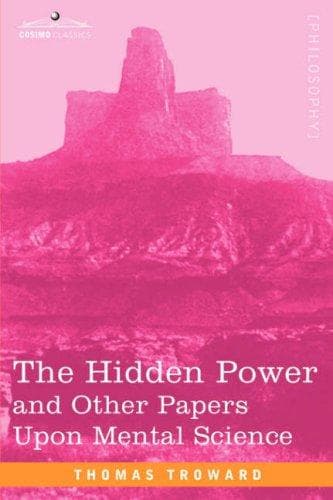
The Hidden Power, and Other Papers upon Mental ScienceTroward, T. (Thomas)
Religion
The Hidden Power, and Other Papers upon Mental Science
Troward, T. (Thomas)
New Thought
A deeply interesting subject to the student of the New Thought movement
is to trace how exactly its teaching is endorsed by the teaching of the
Bible. There is no such thing as new thought in the sense of new Truth,
for what is truth now must have been truth always; but there is such a
thing as a new presentment of the old Truth, and it is in this that the
newness of the present movement consists. But the same Truth has been
repeatedly stated in earlier ages under various forms and in various
measures of completeness, and nowhere more completely than in the
Scriptures of the Old and New Testaments. None of the older forms of
statement is more familiarly known to our readers than that contained in
the Bible, and no other is entwined around our hearts with the same
sacred and tender associations: therefore, I have no hesitation in
saying that the existence of a marked correspondence between its
teaching and that of the New Thought cannot but be a source of strength
and encouragement to any of us who have been accustomed in the past to
look to the old and hallowed Book as a storehouse of Divine wisdom. We
shall find that the clearer light will make the rough places smooth and
the dim places luminous, and that of the treasures of knowledge hidden
in the ancient volume the half has not been told us.
The Bible lays emphatic stress upon "the glorious liberty of the sons of
God," thus uniting in a single phrase the twofold idea of filial
dependence and personal liberty. A careful study of the subject will
show us that there is no opposition between these two ideas, but that
they are necessary correlatives to each other, and that whether stated
after the more concentrated method of the Bible, or after the more
detailed method of the New Thought, the true teaching proclaims, not our
independence of God, but our independence in God.
Such an enquiry naturally centres in an especial manner around the
sayings of Jesus; for whatever may be our opinions as to the nature of
the authority with which he spoke, we must all agree that a peculiar
weight attaches to those utterances which have come down to us as the
_ipsissima verba_ from which the entire New Testament has been
developed; and if an identity of conception in the New Thought movement
can be traced here at the fountain-head, we may expect to find it in the
lower streams also.
Public-domain text, read in full here on John Shaqi.
Reviews
Reviews
No reviews yet
Be the first to share your thoughts on this work.
Elsewhere in the archive
Join the Discussion
Join the discussion
Sign in to leave a comment or review.
Sign InorCreate an account