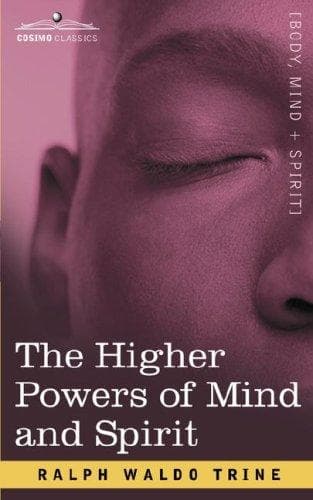
The Higher Powers of Mind and SpiritTrine, Ralph Waldo
Religion
The Higher Powers of Mind and Spirit
Trine, Ralph Waldo
Mind and body; New Thought
Our own achievement of upwards of a hundred years in living in
peaceable, sympathetic and mutually beneficial relations with Canada;
Canada's achievement in so living with us, should be a distinct and
clear-cut answer to the argument that nations need to fortify their
boundaries one against another. This is true only where suspicion,
mistrust, fear, secret diplomacy, and secret alliances hold instead of
the great and eternally constructive forces--sympathy, good will, mutual
understanding, induced and conserved by an International Joint
Commission of able men whose business it is to investigate, to
determine, and to adjust any differences that through the years may
arise. Here we have a boundary line of upwards of three thousand miles
and not a fort; vast areas of inland seas and not a war vessel; and for
upwards of a hundred years not a difference that the High Joint
Commission has not been able to settle amicably and to the mutual
advantage of both countries.
I know that in connection with this we have an advantage over the
old-world nations because we are free from age-long prejudices,
hatreds, and past scores. But if this great conflict does not lead along
the lines of the constructive forces and the working out of a new world
method, then the future of Europe and of the world is dark indeed.
Surely it will lead to a new order--it is almost inconceivable that it
will not.
The Golden Rule is a wonderful developer in human life, a wonderful
harmoniser in community life--with great profit it could be extended as
the law of conduct in international relations. It must be so extended.
Its very foundation is sympathy, good will, mutuality, love.
The very essence of Jesus' entire revelation and teaching was love. It
was not the teaching of weakness or supineness in the face of wrong,
however. There was no failure on his part to smite wrong when he saw
it--wrong taking the form of injustice or oppression. He had, as we have
seen, infinite sympathy for and forbearance with the weak, the sinful;
but he had always a righteous indignation and a scathing denunciation
for oppression--for that spirit of hell that prompts men or
organisations to seek, to study, to dominate the minds and thereby the
lives of others. It was, moreover, that he would not keep silent
regarding the deadly ecclesiasticism that bore so heavily upon his
people and that had well-nigh crushed all their religious life whence
are the very springs of life, that he aroused the deadly antagonism of
the ruling hierarchy. And as he, witnessing for truth and freedom,
steadfastly and defiantly opposed oppression, so those who catch his
spirit today will do as he did and will realise as duty--"While wrong is
wrong let no man prate of peace!"
Peace? Peace? Peace?
While wrong is wrong let no man prate of peace!
He did not prate, the Master. Nay, he smote!
* * * * *
Public-domain text, read in full here on John Shaqi.
Reviews
Reviews
No reviews yet
Be the first to share your thoughts on this work.
Elsewhere in the archive
Join the Discussion
Join the discussion
Sign in to leave a comment or review.
Sign InorCreate an account