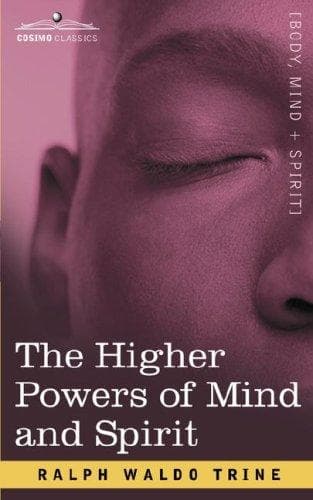
The Higher Powers of Mind and SpiritTrine, Ralph Waldo
Religion
The Higher Powers of Mind and Spirit
Trine, Ralph Waldo
Mind and body; New Thought
Fear can never be a basis of either religion or ethics. The one who is
moved by fear makes his chief concern the avoidance of detection on the
one hand, or the escape of punishment on the other. Men of large calibre
have an unusual sagacity in sifting the unessential from the essential
as also the false from the true. Lincoln, when replying to the question
as to why he did not unite himself with some church organisation, said:
"When any church will inscribe over its altar, as its sole qualification
of membership, the Saviour's condensed statement of the substance of
both law and gospel: Thou shalt love the Lord thy God with all thy
heart, and with all thy soul, and with all thy mind, and thy neighbour
as thyself, that church shall I join with all my heart and soul."
He was looked upon by many in his day as a non-Christian--by some as an
infidel. His whole life had a profound religious basis, so deep and so
all-absorbing that it gave him those wonderful elements of personality
that were instantly and instinctively noticed by, and that moved all men
who came in touch with him; and that sustained him so wonderfully,
according to his own confession, through those long, dark periods of the
great crisis, The fact that in yesterday's New York paper--Sunday
paper--I saw the notice of a sermon in one of our Presbyterian
pulpits--Lincoln, the Christian--shows that we have moved up a round
and are approaching more and more to an essential Christianity.
Similar to this statement or rather belief was that of Emerson,
Jefferson, Franklin, and a host of other men among us whose lives have
been lives of accomplishment and service for their fellow-men. Emerson,
who said: "A man should learn to detect and watch that gleam of light
which flashes across his mind from within, more than the lustre of the
firmament of bards and sages. Yet he dismisses without notice his
thought, because it is his. In every work of genius we recognise our own
rejected thoughts. They come back to us with a certain alienated
majesty." Emerson, who also said: "I believe in the still, small voice,
and that voice is the Christ within me." It was he of whom the famous
Father Taylor in Boston said: "It may be that Emerson is going to hell,
but of one thing I am certain: he will change the climate there and
emigration will set that way."
Public-domain text, read in full here on John Shaqi.
Reviews
Reviews
No reviews yet
Be the first to share your thoughts on this work.
Elsewhere in the archive
Join the Discussion
Join the discussion
Sign in to leave a comment or review.
Sign InorCreate an account