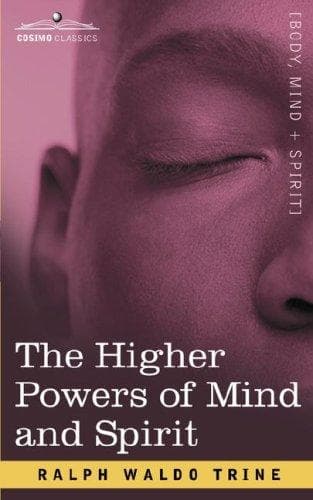
The Higher Powers of Mind and SpiritTrine, Ralph Waldo
Religion
The Higher Powers of Mind and Spirit
Trine, Ralph Waldo
Mind and body; New Thought
How he embraced all--such human sympathy--coming not to destroy but to
fulfil; not to judge the world but to save the world. How he loved the
children! How he loved to have them about him! How he loved their
simplicity, and native integrity of mind and heart! Hear him as he says:
"Verily I say unto you, Whosoever shall not receive the Kingdom of God
as a little child, he shall not enter therein"; and again: "Suffer the
little children to come unto me, and forbid them not; for of such is the
Kingdom of God." The makers of dogma, in evolving some three hundred
years later on the dogma of the inherent sinfulness and degradation of
the human life and soul, could certainly find not the slightest trace of
any basis for it again in these words and acts of Jesus.
We find him sympathising with and mingling with and seeking to draw unto
the way of his own life the poor, the outcast, the sinner, the same as
the well-to-do and those of station and influence--seeking to draw all
through love and knowledge to the Father.
There is a sense of justice and righteousness in his soul, however, that
balks at oppression, injustice, and hypocrisy. He therefore condemns and
in scathing terms those and only those who would seek to place any
barrier between the free soul of any man and his God, who would bind
either the mind or the conscience of man to any prescribed formulas or
dogmas. Honouring, therefore the forms that his intelligence and his
conscience allowed him to honour, he disregarded those that they did
not.
Like other good Jewish rabbis, for he was looked upon during his
ministry and often addressed as Rabbi, he taught in the synagogues of
his people; but oftener out on the hillsides and by the lake-side, under
the blue sky and the stars of heaven. Giving due reverence to the Law
and the Prophets--the religion of his people and his own early
religion--but in spirit and in discriminating thought so far
transcending them, that the people marvelled at his teachings and
said--surely this a prophet come from God; no man ever spoke to us as he
speaks. By the ineffable beauty of his life and the love and the
winsomeness of his personality, and by the power of the truths that he
taught, he won the hearts of the common people. They followed him and
his following continually increased.
Through it all, however, he incurred the increasing hostility and the
increasing hatred of the leaders, the hierarchy of the existing
religious organisation. They were animated by a double motive, that of
protecting themselves, and that of protecting their established
religion. But in their slavery to the organisation, and because unable
to see that it was the spirit of true religion that he brought and
taught, they cruelly put him to death--the same as the organisation
established later on in his name, put numbers of God's true prophets,
Jesus' truest disciples to death, and essentially for the same reasons.
Public-domain text, read in full here on John Shaqi.
Reviews
Reviews
No reviews yet
Be the first to share your thoughts on this work.
Elsewhere in the archive
Join the Discussion
Join the discussion
Sign in to leave a comment or review.
Sign InorCreate an account