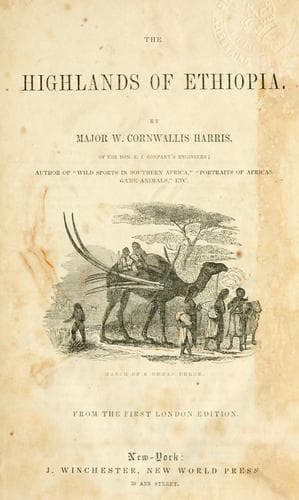
The Highlands of EthiopiaHarris, William Cornwallis, Sir
History
The Highlands of Ethiopia
Harris, William Cornwallis, Sir
Ethiopia -- Description and travel
South-westward of the valley of Aussa are the independent Adaiel tribes
Hurruk Bodaito, over whom presides Gobuz Elincha, a powerful chieftain,
who has espoused Leni, daughter of Birru Lubo, the Prince of Argobba,
and through whose territories lies the high caravan route to Dowwe, with
which the traffic is considerable. On the north, the Mudaito are
bounded by the distinct nation styled Hirto, under the rule of Yingool
Ali--Mohammadans, deriving their origin from the Arab invaders of the
seventh century, and speaking a language not very dissimilar from the
Adaiel, who claim the same descent.
Aussa is still the abode of all the Uleemas, Aukal, and learned doctors,
for whom the Mudaito have ever been renowned, but the present government
is singularly constituted. The aged Sultan Humferi, son of Yoosuf Ali
ibn Ajdahis, has retained with his high-sounding title the mere shadow
of authority, which is in truth vested in Mohammad Ali, the vicegerent
of the Debenik-Woema, appointed by general suffrage from Tajura.
Residing at Kulloo, and ruling with an iron hand, he admits of little
interference; and, in all cases where disputes between the "red" and
"white" houses of the proprietors of the soil and their invaders,
terminate fatally to the latter, takes two lives for one, according to
the immemorial observance in blood feuds.
Ameer Sulaam, the Wuzir of the Mudaito, is head of all the sages, and he
is aided in the administration of justice by Hurrur Hassan, Teeoh, and
Berbera or "Pepper" Ali, the latter so styled from the volubility of his
sarcastic tongue. This triumvirate of venerable sheikhs, whose wisdom
and learning is reputed to be _kum el bahr_, "profound as the sea," is
referred to on all occasions where knotty points are at issue, whether
amongst the Ado-himera or Mudaito; and even the Sultan of Tajura was on
a late occasion held bound to abide by their arbitration, relative to
the projected marriage of his son to a bride from another clan of the
"white house," a measure which was resisted, and which he was desirous
of enforcing. Yet a transit duty of fifty per cent, is levied by
Mohammad ibn Mohammad upon all exports made by the Mudaito, whereas ten
per cent, only is exacted from the numerous Danakil tribes.
"A large Arab force from Zeyla," observed Ibrahim Shehem Abli, who was
well versed in the chronicles of Aussa, "was induced to join the
Debenik-Woema in their invasion of the predatory Mudaito hordes; and
overtures of capitulation having been made by Yoosuf Ali ibn Ajdahis,
they were thrown off their guard. During the night the Woema, who knew
with what villains they had to deal, bivouacked upon the heights of
Dugodlee and Hy Tunkoma, where they rested safely enough. But the
blockheads of Arabs choosing to sleep in the plain, the garrison took
advantage of their folly to make a _goom_: and so cleverly was it
managed, that by Allah! they succeeded in drawing their creeses across
the throats of all save one."
Public-domain text, read in full here on John Shaqi.
Reviews
Reviews
No reviews yet
Be the first to share your thoughts on this work.
Elsewhere in the archive
Join the Discussion
Join the discussion
Sign in to leave a comment or review.
Sign InorCreate an account