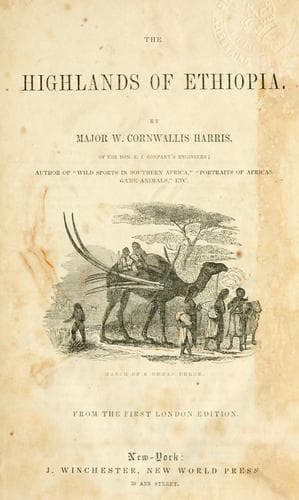
The Highlands of EthiopiaHarris, William Cornwallis, Sir
History
The Highlands of Ethiopia
Harris, William Cornwallis, Sir
Ethiopia -- Description and travel
In the dead of night an alarm caused all to spring from their couches on
the hard ground, and to stand prepared for the reception of an unseen
foe, whose approach was announced by the blast of some hideous war-horn.
Halters had been broken, and mules and horses were charging over the
tent ropes, nor was the real cause of the confusion discovered for some
minutes. A thirsty dog, unacquainted with the artifice resorted to by
the fox that needed water, had recklessly thrust his mangy head so deep
into an earthen jar that he was unable to withdraw it, and rushing he
knew not whither, was giving vent through his strange proboscis to
fearful hollow groans, which might well have instilled terror into the
breast of the superstitious, and did not fail to elicit ceaseless howls
from the canine occupants of the dunghill.
The delinquent was shot, and order being at length restored, those who
were entitled to slumber again proceeded to avail themselves of the
privilege. After pacing his beat some hours beyond the wonted period of
relief, the sentinel who mounted at midnight hailed the officer on duty.
Receiving no reply to the challenge, he approached the door of the
tent, and there, sad to relate, the first breach of discipline was
detected on the part of the guardian of the camp, who, worn out by
incessant vigils, was on this, his last watch, lying fast asleep upon
his post, with a pistol in each hand!
Volume One, Chapter XXXVIII.
A PARTING TRIBUTE OF GRATITUDE INSCRIBED TO THE PEOPLE OF ADEL.
Tradition asserts that prior to the invasion of Graan, "the mighty Adel
monarch," who overran and dismembered once-powerful Ethiopia, the
eastern limit of the empire was Jebel Aiulloo, known to the Abyssinians
as Mount Azulo. But although frequently invaded, no portion of the wide
plain of the Hawash has been reconquered, whether by Sahela Selassie, or
by his ancestors. The relatives of certain of those in authority have
been made prisoners by treachery, and as hostages are held in close
durance by the king, but the boasted influence of the Abogaz is
principally supported by conciliation, and by the annual presentation of
cloths and specie to the various chiefs and elders--a measure having for
its object to preserve the avenues to the sea-coast and to the Bahr
Assal, whereon Shoa and Efat are almost entirely dependant for foreign
wares, and for salt, which the country does not produce.
Public-domain text, read in full here on John Shaqi.
Reviews
Reviews
No reviews yet
Be the first to share your thoughts on this work.
Elsewhere in the archive
Join the Discussion
Join the discussion
Sign in to leave a comment or review.
Sign InorCreate an account