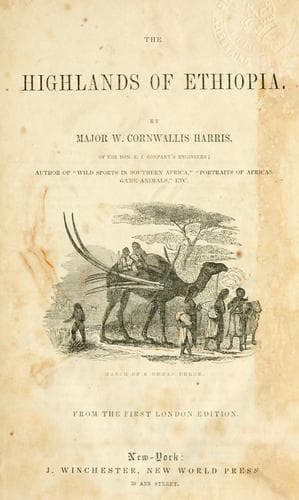
The Highlands of EthiopiaHarris, William Cornwallis, Sir
History
The Highlands of Ethiopia
Harris, William Cornwallis, Sir
Ethiopia -- Description and travel
The Adaiel or Danakil population, which, including the Mudaito, extends
as far as Arkeeko, entitles itself Afer, and claims to be descended from
Arab invaders, who, in the seventh century of the Christian era, overran
and colonised the low tract which forms a zone between the Abyssinian
Alps and the coast of the Red Sea. To a certain extent the northern
tribes are subject to the Nayib of Arkeeko, whose authority is
recognised in much the same proportion as that of the feeble Sultan of
Tajura by the southern clans; but although speaking the same language,
they can hardly be said to constitute a nation, being so widely
dispersed, that for many days together not a trace of man is to be
discovered over the joyless deserts which form the lot of his
inheritance, scorched by an ardent sun, and alive only with "moving
pillars of sand."
From time immemorial every individual has been his own king. Each
marauding community is marked by a wild independence; and the free
spirit of the whole is to be traced in the rapine, discord, and
bloodshed which universally prevails. Theirs is "an iron sky, and a
soil of brass," where the clouds drop little rain, and the earth yields
no vegetation. It is no "land of rivers of water," nor have the "lines
fallen in pleasant places." The desert stretches far on every side,
strewed with black boulders of heated lava, and enveloped by a glowing
atmosphere. In this country of perfidy and vindictive ferocity, the
proprietors of the barren land murder every stranger who shall intrude;
and the common benefits of water are an object of perpetual contest.
Reprisal and revenge form the guiding maxim of all. Monsters, not men,
their savage propensities are portrayed in a dark and baleful eye, and
the avenger of blood is closely dogging the footsteps of one half the
population.
As laziness is the chief source of African misery at large, so is it
with the Danakil in particular. They possess that "conceit in their
misery" which induces them to despise the labours of the cultivator; and
such is the characteristic want of water, that, excepting at Aussa,
agriculture is unknown, even in its rudest form. A pastoral, itinerant,
and belligerent people, divided into endless clans and ramifications,
under divers independent chieftains, their mode of living entitles them
to rank only one step in civilisation above the positive savage who
depends for daily subsistence upon the chase and upon the spontaneous
productions of nature.
Public-domain text, read in full here on John Shaqi.
Reviews
Reviews
No reviews yet
Be the first to share your thoughts on this work.
Elsewhere in the archive
Join the Discussion
Join the discussion
Sign in to leave a comment or review.
Sign InorCreate an account