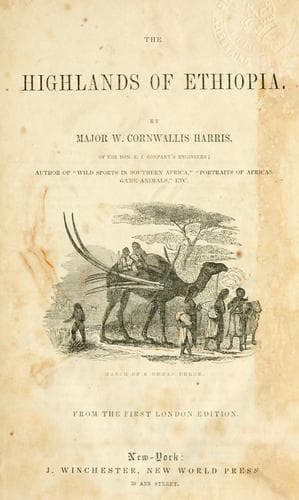
The Highlands of EthiopiaHarris, William Cornwallis, Sir
History
The Highlands of Ethiopia
Harris, William Cornwallis, Sir
Ethiopia -- Description and travel
Amongst the Danakil are to be found some of the most scowling,
ill-favoured, and hideous-looking savages in the universe, but the
features of the majority have an Arab cast which supports the legend of
their origin; and notwithstanding the influence exerted upon the
lineaments by passions uncontrolled, the expression of many is pleasing,
and even occasionally intellectual. All are muscular and active, but
singularly scraggy and loosely knit, and to an easy shuffling gait is
added a national addiction to standing cross-legged. Young as well as
old take infinite pains to disfigure the person, and thus to render it
ferocious in appearance. Scars obtained in brawls and conflicts from
stones and cold steel are esteemed the highest ornaments, and the breast
and stomach are usually seamed with a mystic maze of rhombs and
reticulated triangles, produced by scarification with a sharp fragment
of obsidian, so as to resemble the plan of a fortified town of days gone
by.
The upper lip is denuded with the creese, and the scanty beard suffered
to flourish in curls along the cheeks and over the chin; whilst the
hair, coarse and long, saturated with grease and mutton fat from
infancy, and exposed during life to the fiercest sun, becomes crisped
into a thick curly mop, like a counsellor's wig, which is shaved behind
on a line between the ears, and constitutes the first great pride of the
proprietor. The picking it out into a due spherical form affords
employment during his ample leisure, and the contemplation of its wild
perfection is the predominant object when the mirror is placed within
his grasp. Baldness commences at an early age, and many of the ancient
dandies seek protection from the solar influence under sheep-skin
perukes of preposterous size, their artificial curls, in common with
those that are natural, displaying an ornamented wooden spike or bodkin,
which serves as a comb, and is often fancifully carved and provided with
two or even three prongs.
Public-domain text, read in full here on John Shaqi.
Reviews
Reviews
No reviews yet
Be the first to share your thoughts on this work.
Elsewhere in the archive
Join the Discussion
Join the discussion
Sign in to leave a comment or review.
Sign InorCreate an account