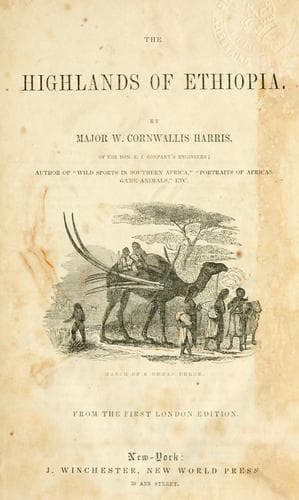
The Highlands of EthiopiaHarris, William Cornwallis, Sir
History
The Highlands of Ethiopia
Harris, William Cornwallis, Sir
Ethiopia -- Description and travel
Morose, and possessing little perception of the ridiculous, witticisms
and hilarity in conversation are restricted to the ribald jest; but
brawls are frequent, and the bivouac is often cheered by the wild chorus
selected from a choice collection breathing in every line
self-sufficiency and defiance to the foe. Accompanied by savage
gestures and contortions--now menacing, now mincing, and now furious--
these strains are chanted during the livelong night with clear and
energetic throats, chiefly with the design of intimidating, by the noisy
clamour, any hostile party that may be lurking in the vicinity of the
encampment, intent either upon the requital of injuries done, or the
acquisition of fame by aggressions unprovoked.
Superstitious to the last degree, the itinerant Bedouin takes the field
arrayed in a panoply of amulets, designed as a defence against
witchcraft, and to be thrown towards the enemy in the hour of battle. A
verse from the Koran, sewn up in leather, and hung about the neck,
secures him against all incorporeal enemies. No whirlwind ever sweeps
across the path without being pursued by a dozen savages with drawn
creeses, who stab into the centre of the dusty column in order to drive
away the evil spirit that is believed to be riding on the blast. All
have firm faith in the incarnation of the Devil, who is described as a
monster with perpendicular eyes, capable of rolling along the ground
with the rotatory motion of a ball; and Ibrahim Shehem Abli, a most
unblushing liar, and no less notable a necromancer than warrior,
confidently asserted his individual ability to raise seven hundred of
these demons for evil, during any moonlight night of the entire year.
The mosque and the muezzin have no existence in the interior, where
religion gradually shades away; and, unlike the people of Tajura, there
is here little external display of Islamism observable, save in the
bigoted detestation evinced towards those of every other than the
Mohammadan creed. But although prostrations are wanting, and rosaries
are untold, the vagrants still preserve their knavish reputations
unblemished. The white feather, which in Europe is the emblem of
cowardice, is appropriately placed in the head of these midnight
assassins, and the neighbouring tribes have not ill-portrayed the
national character in the assertion, that "the tongues of the Adaiel are
long for the express purpose of lying, that their arms are long but to
admit of their pilfering the property of others, and that their legs are
long in order that they may run away like poltroons in the day of danger
and retribution."
Volume One, Chapter XXXIX.
THE GENTLE ADAIEL, AND FAREWELL TO THEM.
"Yet one kind kiss before we part,
Drop a tear, and bid adieu."
Public-domain text, read in full here on John Shaqi.
Reviews
Reviews
No reviews yet
Be the first to share your thoughts on this work.
Elsewhere in the archive
Join the Discussion
Join the discussion
Sign in to leave a comment or review.
Sign InorCreate an account