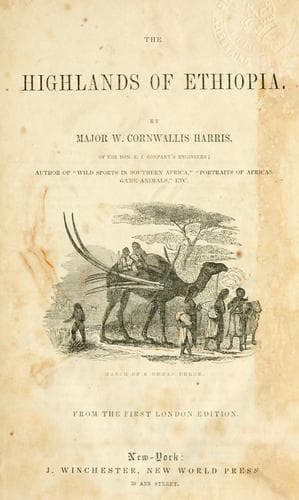
The Highlands of EthiopiaHarris, William Cornwallis, Sir
History
The Highlands of Ethiopia
Harris, William Cornwallis, Sir
Ethiopia -- Description and travel
In advance of the time, however, these luckless individuals had ventured
to speculate to their envious countrymen upon the advantage to be
derived from foreign traffic and the presence of the white man. The
incautious word had caught the ear of Abdel Yonag, the wily chief of the
Hurrurhi, and letters were secretly despatched to his master the Ameer,
representing the wealthy hajjis to be men of turbulent and ambitious
views, who had devised dangerous innovations, and were plotting, with
the Adaiel, the monopoly of the commerce in slaves. With hearts
bounding at the sight of their native minarets, and utterly unconscious
of the slander that had preceded them, the pilgrims entered the
_Isma-deen_ gate of the city; but ere return had been welcomed by wife
or child, they were hurried by the soldiery to the presence of the
despot, and, without even the mockery of a trial, were beaten to death
with huge maces of iron.
The independent principality of Hurrur is a spot yet unvisited by any
European, and is remarkable for its isolated position among the Pagan
and Mohammadan Galla, against whose continual inroads it has hitherto
contrived, with the aid of two hundred matchlock-men and a few archers,
to maintain its integrity. The Alla, the Nooli, the Geeri, the Tarsoo,
the Babili, the Bursoo, the Burteera, and the Gooti, compass it on every
side, and making sudden descents, sweep the ripe crops from off the face
of the smiling land; but their efforts against the town have uniformly
proved unsuccessful, and caravans continue, in spite of hostilities, to
carry on a very considerable traffic through the Ittoo and Aroosi
tribes, with Shoa and the Somauli coast.
Originally founded and peopled by a colony of the sons of Yemen, the
town is described to be situated in a pleasant and well-watered valley,
surrounded by hills, and enjoying a cool and salubrious climate. A wall
of mud and stone, six miles in circumference, with five fortified gates,
affords security to the entire population, whose houses, many of them
two-storied, are constructed of stone, whitewashed, and terraced.
Mosques and minarets are conspicuous in every street. The matin voice
of the muezzin is regularly heard, and the Jama el Musjid is believed to
be the abode of guardian angels, who stretch the strong pinion of
protection over the heads of the Faithful. "How could Hurrur have
triumphed thus long over the unbelievers," inquire the devout citizens,
"had Allah not extended his right arm to succour the followers of his
Prophet?"
Public-domain text, read in full here on John Shaqi.
Reviews
Reviews
No reviews yet
Be the first to share your thoughts on this work.
Elsewhere in the archive
Join the Discussion
Join the discussion
Sign in to leave a comment or review.
Sign InorCreate an account