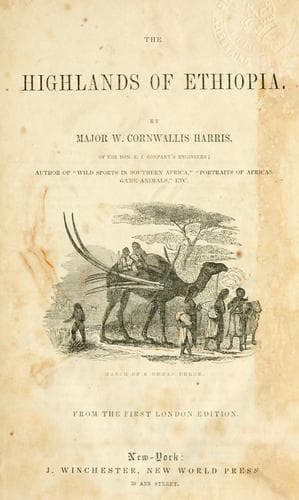
The Highlands of EthiopiaHarris, William Cornwallis, Sir
History
The Highlands of Ethiopia
Harris, William Cornwallis, Sir
Ethiopia -- Description and travel
Around Hurrur the soil is rich, and extensively cultivated, especially
in coffee. Two thousand bales of the finest quality are annually
exported into India and Arabia by the ports of Zeyla and Berbera, which
are visited thrice during the year by large caravans laden with ivory,
ostrich feathers, ghee, saffron, gums, and myrrh, which latter is
produced in great abundance. Blue and white calico, Indian piece goods,
English prints, silks, and shawls, red cotton yam, silk thread, beads,
frankincense, copper wire, and zinc, are received in exchange, and a
transit duty of one _frazil_ of the latter metal is levied by the Ameer
on every slave passing through his dominions from the cold hills of his
brother of Shoa, where these commodities are bartered.
[The distance of Hurrur from Zeyla may be assumed at 150 miles
south-south-west and from Ankober, 190 miles East.]
Between Aboo Bekr and the Christian monarch the most friendly
intercourse subsists. Letters continually pass and repass, and scarcely
a month elapses without the arrival of a caravan. The chief of the Wurj
or merchants of Hurrur, standing specially appointed by the Ameer,
possesses absolute power to punish all offences, and adjust all disputes
amongst his own countrymen, who are not less fond of drawing the creese
than their Adaiel brethren. Tullah, an inferior description of beer,
being brewed and swallowed in alarming quantities, brawls and scuffles
too frequently terminate the debauch in blood. Should a Christian
subject of Shoa be slain, the offence is passed over in politic silence,
but when the reverse is the case, the worldly wealth of the sinning
Abyssinian is confiscated by the crown, and his person handed over to
the tender mercies of the Moslem savages.
The continual change of inhabitants, the excessive cheapness of
provisions, and the prevalent custom of hand-fasting for the visit, tend
little to improve the morality of the market-town. The chains of the
convenient alliances formed, are by no means binding on either party,
and the sum of twopence-halfpenny is perfectly sufficient to support
during the week the trader and his temporary mate. One hundred pieces
of salt are considered a large dowry; the nuptials are celebrated by
feasting and routing alone, and whilst the utmost indifference prevails
on the part of the husband, he loosens the matrimonial knot at pleasure,
by carrying his partner before the kazi, and thrice repeating the words,
"Woman, I thee divorce."
Public-domain text, read in full here on John Shaqi.
Reviews
Reviews
No reviews yet
Be the first to share your thoughts on this work.
Elsewhere in the archive
Join the Discussion
Join the discussion
Sign in to leave a comment or review.
Sign InorCreate an account