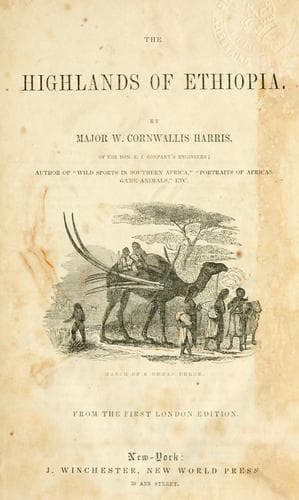
The Highlands of EthiopiaHarris, William Cornwallis, Sir
History
The Highlands of Ethiopia
Harris, William Cornwallis, Sir
Ethiopia -- Description and travel
Instantly on emerging from the forest, the metropolis of Shoa, spreading
far and wide over a verdant mountain, shaped like Afric's appropriate
emblem, the fabled sphynx, presented a most singular if not imposing
appearance. Clusters of thatched houses of all sizes and shapes,
resembling bams and haystacks, with small green enclosures and splinter
palings, rising one above the other in very irregular tiers, adapt
themselves to all the inequalities of the rugged surface; some being
perched high on the abrupt verge of a cliff, and others so involved in
the bosom of a deep fissure as scarcely to reveal the red earthen pot
which crowns the apex. Connected with each other by narrow lanes and
hedgerows, these rude habitations, the residence of from twelve to
fifteen thousand inhabitants, cover the entire mountain-side to the
extreme pinnacle--a lofty spire-like cone, detaching itself by a narrow
isthmus to form the sphynxs head. Hereon stands the palace of the
Negoos, a most ungainly-looking edifice with staring gable ends, well
fortified by spiral lines of wooden palisades. They extend from the
base to the summit, and are interspersed with barred stockades, between
which are profusely scattered the abodes of household slaves, with
breweries, kitchens, cellars, storehouses, magazines, and granaries.
Over those portions unengrossed by cultivation or by architecture,
shrubs and bushes and great beds of nettles assumed the most luxuriant
and lively appearance. Huge fallen masses of rock strewed the lower
valleys, and others seemed ready to be launched at a moment's notice
upon the clustering habitations; whilst in the distance, the bronze
cross of the church of "our Lady," peeping above the dark foliage of the
juniper, touched the chord of feelings but little in unison with the
wild escort that surrounded us, above whose streaming locks floated
bloody emblems, that breathed aught save conformity to the mild tenets
of the Christian religion.
Public-domain text, read in full here on John Shaqi.
Reviews
Reviews
No reviews yet
Be the first to share your thoughts on this work.
Elsewhere in the archive
Join the Discussion
Join the discussion
Sign in to leave a comment or review.
Sign InorCreate an account