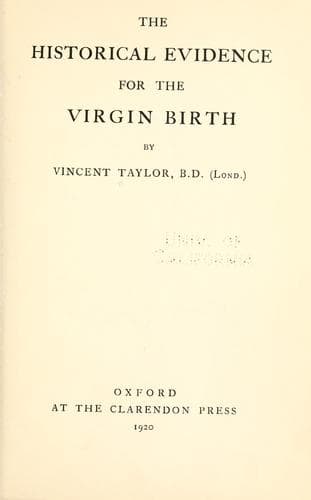
The Historical Evidence for the Virgin BirthTaylor, Vincent
Religion
The Historical Evidence for the Virgin Birth
Taylor, Vincent
Bible. Gospels; Jesus Christ -- Nativity; Virgin birth
(1) In answer to the first question, our view is that _each Gospel, in a
different way, is a witness to the same tradition_. Too much has
frequently been made of the theory that in Mt. and Lk. we have two
independent accounts of the Virgin Birth tradition. It may seriously be
questioned if this theory is true. Mt. i. 18‐25 is misunderstood if it is
explained as a Virgin Birth tradition. Like the rest of cc. i, ii, its
character is Midrashic, and it is written from an apologetic standpoint.
It would therefore be much truer to say that it _implies_ the existence of
a Virgin Birth tradition as known to the readers of the Gospel. What form
that tradition took we are of course unable to say. It is possible that it
was similar to the tradition as it appears in Lk. On the other hand, it
may be that even in Lk. the form in which the tradition is presented owes
something to the Evangelist’s craftsmanship. If this is so, it would seem
that the narratives of both writers point back to a simpler tradition or
belief, from which, in different ways, they came to assume their present
form. What is of chief importance is the view that in both Gospels we
have, not so much two independent narratives of the Virgin Birth, as
rather two independent witnesses to what originally was one and the same
tradition.
It cannot escape our notice that, in spite of their obvious differences,
Lk. i. 34 f. and Mt. i. 18‐25 contain what is substantially the same
statement, a statement which in each passage is central. In Mt. i. 20 we
read: “_That which is conceived_ (τὸ ... γεννηθέν) _in her is of the Holy
Spirit_”; and in Lk. i. 35, after the reference to the Holy Spirit, we
read: “_That which is to be born_ (τὸ γεννώμενον) _shall be called holy,
the Son of God_”. There is much to be said for the view that both
expressions point back to a common original, to a primitive belief that
Jesus was “born of the Holy Spirit” (cf. Harnack, _Date of Acts_, &c., pp.
142 ff.).
If then we are unable to accept the view that in Mt. and Lk. we have two
independent accounts of the Virgin Birth, we may well ask if the loss is a
real one. It is probably nothing of the kind. There was indeed a certain
advantage in feeling able to point to two diverse traditions which
converged upon one fact. Nevertheless, the argument always had a certain
weakness. We had to account for the two different traditions, and the
explanation was a theory we could never prove. It may be that St. Luke’s
story goes back for its authority to Mary; it is very doubtful if St.
“Matthew’s” has any historical connexion with Joseph; but in either case
neither assumption is justifiable in an historical inquiry. It must be
allowed, we think, that our view has sounder advantages. Instead of
claiming validity for two diverse traditions, we can point to two very
different narratives, which arise out of the same belief and are
independent witnesses to its existence in the primitive Christian
community.
Public-domain text, read in full here on John Shaqi.
Reviews
Reviews
No reviews yet
Be the first to share your thoughts on this work.
Elsewhere in the archive
Join the Discussion
Join the discussion
Sign in to leave a comment or review.
Sign InorCreate an account